Wednesday, December 1, 2010

MAX CLIFFORD...Keeping the lid on Dewani

Dewani never wants to return to Cape Town’

.
Shrien Dewani, the widower of murdered honeymoon tourist Anni Dewani, does not want to return to Cape Town ever again.

Shrien Dewani, the widower of murdered honeymoon tourist Anni Dewani, does not want to return to Cape Town ever again.

This is what Max Clifford, the British public relations specialist Dewani has hired, told the Cape Times on Tuesday in a telephonic interview from London.

“The last place in the world he ever wants to go to again is Cape Town. But in order to help police ... he’ll do so,” Clifford said.

It was not yet clear if and when Dewani, 30, would return to Cape Town and, according to Clifford, the police have not requested his return.

Clifford said Dewani was currently staying at his home near Bristol under a doctor’s supervision as the strain of his wife’s murder and the media speculation about it had affected his health.

“He’s been through so much trauma and shock as you can imagine.

“He was madly in love with someone and very, very happy. That was destroyed in a minute. It turned into the worst nightmare in a minute.”

Clifford said media reports suggesting Dewani was a suspect in his wife’s murder were false and had taken a toll on Dewani and his family.

“It’s obviously made a horrible nightmare even worse. So many lies have come out of South Africa that (the family is) getting used to it.”

Reports saying Dewani’s marriage to Anni had been arranged were false as were reports Dewani had taken out a life insurance policy on his wife, meaning he would have received a large sum of money if she died, Clifford said.

He said the relationship between Anni’s family, the Hindochas, and the Dewani family had not been negatively affected as some newspapers had claimed.

“On Saturday, Anni’s father phoned Shrien’s father and apologised for all the comments he never said, but which appeared in the papers.”

Clifford said the South African media was reporting “one lie after another day to day” and he was not sure who the source of the inaccurate information was.

“You tell me. You’re there.”

He did not say anything negative about British newspapers. “According to my sister, who lives in South Africa, it’s very predictable. Billy Gundelfinger (Dewani’s Johannesburg-based attorney) says this is the way (the media) does it in South Africa.”

Clifford had received more than 200 requests from reporters wanting to speak directly to Dewani, but was currently speaking on his behalf. “When he’s well enough he’ll speak. And definitely to South African reporters.”

Dewani was not keeping in touch with South African police and was relying on Gundelfinger to keep him up to date. “Police have just contacted him to say ‘you’re not a suspect’,” Clifford said.

On Tuesday, colleagues of Charlotte Harris, a British attorney Dewani has hired along with Gundelfinger, referred queries to Clifford. Gundelfinger has not yet responded to queries or returned calls.
On Monday, Anni’s father Vinod Hindocha spoke about his daughter, but refused to defend or attack Dewani.

That day, three men accused of killing his daughter, Mziwamadoda Qwabe, 25, Xolile Mngeni, 23, and Zola Robert Tongo, 31, appeared in the Wynberg Regional Court, where the case was postponed to next Monday.

Details about a plea agreement involving Tongo, who was driving Shrien and Anni Dewani when they were hijacked, are expected to emerge then. Police are reportedly looking for a fourth suspect, but are refusing to comment.
caryn.dolley@inl.co.za - Cape Times

http://www.iol.co.za/news/crime-courts/dewani-never-wants-to-return-to-cape-town-1.894590

Interesting comments section at link provided


Clarence Mitchell who lied , lied and lied some more to protect the McCanns and still the British public believe the McCanns are involved in their daughters disappearance. Lets see if Max Clifford will be as smart when the chips start to fall on what really happened to Anni Dewani. These two men would sell their mothers if the price was right...
http://www.gerrymccannsblogs.co.uk/PJ/KATERINA-PAYNE-INCIDENT.htm

The McCanns refused to hand over Madeleines medical records...with the releasing of the news that JonBenet was an abused child we have to now ask was Madeleine McCann an abused child and if she was why is the might of the British Goverment covering it up ?

HARPER ADVISER.....FATWA AGAINST ASSANGE

WikiLeaks US embassy cables: live updates

• Mervyn King's damning views on Cameron and Osborne
• Lib Dems drop attack against Cameron after Ivan's death
• US and UK fears over Pakistan's nuclear weapons
• Pakistan army sponsoring militants as cash goes missing
• Full coverage of the WikiLeaks cables

This page will update automatically every minute: On | Off
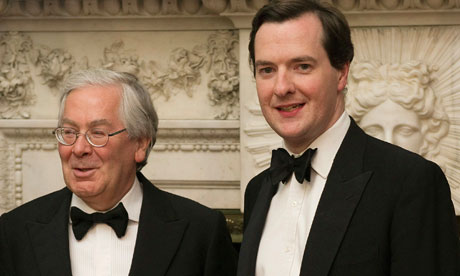
Mervyn King and George Osborne on 16 June 2010
The head of the Bank of England Mervyn King privately criticised David Cameron and George Osborne for their lack of experience, the lack of depth in their inner circle and their tendency to think about issues only in terms of their electoral impact, according to leaked US embassy cables. Photograph: Carl Court/AFP/Getty Images

11.55am: Downing Street sounds a little exasperated by the continuing questions about WikiLeaks in general and Mervyn King's comments in particular. Here are the latest lines from PA.
Cameron's spokesman refused to answer questions about the WikiLeaks documents at a regular daily media briefing in the House of Commons.
In response to further questions, he said that the prime minister believes the governor is doing a "good job", but declined to respond when asked whether he retains Mr Cameron's confidence.
"The issue of confidence simply doesn't arise," he said.
11.47am: US officials tried to influence Spanish prosecutors and government officials to head off court investigations into Guantánamo Bay torture allegations, secret CIA "extraordinary rendition" flights and the killing of a Spanish journalist by US troops in Iraq, writes Giles Tremlet in Madrid.
11.40am: Prime minister's questions at midday. It is sure to be spiced by Mervyn King's comments about Osborne and Cameron. Andrew Sparrow will be covering on the the politics live blog.
11.33am: Hillary Clinton has emerged from that OSCE summit in Kazakhstan to answer more questions about WikiLeaks.
She said had discussed the the leaked cables with her international colleagues, according to AP.
11.24am: One of the cables quoted Tory party officials in October 2008 expressing concern about George Osborne's "high-pitched vocal delivery".
A month later the Daily Mail published a story about Osborne having voice-coaching lessons from a £100-per-hour Harley Street expert.

Some observers claim that in the past year his voice has dropped in tone and his speaking style sounds less posh.
11.01am: The British government gave secret assurances that it would "protect US interests" at the Chilcot inquiry, the Telegraph reports.
10.40am: William Hague said he, David Cameron and George Osborne were all "children of Thatcher" and staunch Atlanticists, according to one of the latest cables to be released.
10.25am: The Bank of England has issued a terse statement in support of King. "The governor has a very effective working relationship with both the chancellor and the prime minister," a spokesman said.
10.17am: Nick Clegg was sent to Kazakhstan for that tricky OSCE summit with Hillary Clinton. He said the leaks of the US cables would not harm the UK's "uniquely strong relationship" with the US.
Following his discussion with Clinton in the Kazakh capital Astana, Clegg said:
We discussed a wide range of issues, including Iran, Pakistan, Afghanistan, the Middle East peace process and Sudan.
I made clear to Secretary Clinton that recent WikiLeaks disclosures would not affect our uniquely strong relationship. UK-US co-operation will continue with the same depth and closeness as before.
10.05am: Mervyn King should resign, says his former monetary policy committee colleague, David Blanchflower.
Mervyn King is one smart guy and that has always been abundantly clear. Unfortunately, it is his thirst for power and influence that has clouded his judgment one too many times. He has now committed the unforgivable sin of compromising the independence of the Bank of England. He is expected to be politically neutral but he has shown himself to be politically biased and as a result is now in an untenable position. King must go.
9.35am: Yet more rabid reaction in America. Former Pentagon official KT McFarland, said Manning should be executed and WikiLeaks declared a terrorist organisation.
9.24am: More WikiLeaks hysteria. The Republican presidential hopeful Mike Huckabee said the person responsible for the leaks should face the death penalty.
"Whoever in our government leaked that information is guilty of treason, and I think anything less than execution is too kind a penalty," Huckabee said according to Politico.
9.20am: The respected Middle East analyst Juan Cole finds evidence in the latest cables of British impatience with the diplomatic process last year over Iran's nuclear programme.
One cable shows Simon McDonald, head of the foreign and defence policy secretariat at the Cabinet Office, said Gordon Brown wanted to impose a 30-day deadline on Iran.
"That sort of impatience does not comport with genuine diplomacy, and it seems clear that the British were eager to impose further sanctions as soon as possible," Cole writes.
He said the cable also suggested that the UK and the US wanted to get hold of Yukiya Amano, the then incoming head of the International Atomic Energy Agency, and "twist his arm to be more alarmist in his reports on Iran."
8.55am: US state department spokesman PJ Crowley was repeatedly pressed to explain disclosures that US diplomats were ordered to spy on the UN leadership.
We've published an extended extract of the exchange. It included this defence from Crowley:

Diplomats are diplomats and their job is to interact with people, gather information, gain a perspective of events around the world, and report those findings in a way that helps inform our policies and inform our actions. They are not intelligence assets. It can be useful for a diplomat to understand from Washington – you have a diplomat out in any place in the world, hey, there are issues that are of particular interest to the United States government. If you come across information that might be relevant to these issues, let us know. That's … those are … that is something that diplomats actually do every day. But one particular cable does not turn a diplomat into an intelligence asset.
8.38am: The anti-WikiLeaks campaign is now becoming hysterical. Tom Flanagan, an adviser to the Canadian prime minister Stepher Harper, called for the assassination of Julian Assange on a CBC news programme.

The "shockingly flippant" comment is being seen as a fatwa against Assange.
8.29am: The leaks are "embarrassing" and "awkward," the US defence secretary Robert Gates admitted last night. But he said the consequences for American foreign policy should be limited. CNN uploaded this video of his remarks.

8.08am: Hillary Clinton faces an awkward time today at a summit of the Organization for Security and Co-operation in Europe in Kazakhstan. Among the delegates are the UN secretary general Ban Ki-moon, who US diplomats were instructed to spy on, along with other UN leaders.
Meanwhile, Hillary's husband Bill said he expects lives will be lost as a result of the leaked cables.
"I'll be very surprised if some people don't lose their lives," the former president said in a speech in North Carolina, according to AP. "And goodness knows how many will lose their careers."
Speaking to reporters after the event Bill Clinton said Julian Assange is trying to evade the reach of American law because he knows what he did was criminal.
"That doesn't mean that he did succeed in evading the reach of American law," he said.
7.57am: Prince Andrew is also under the cosh.
Republic spokesman Graham Smith said today: "On one hand Andrew is seeking private briefings from the Serious Fraud Office, on the other he is railing against the SFO and apparently condoning bribery in the course of international trade."
Still not a peep from Buckingham Palace on all this.
7.39am: Interpol is on his back, Sarah Palin wants him to be hunted down like a terrorist – it couldn't get much worse for Julian Assange, and now his mum has now piped up to talk of her distress at his plight.
According to the Sydney Morning Herald she said: "He's my son and I love him and obviously I don't want him hunted down and jailed. I'm reacting as any mother would – I'm distressed."
She added: "A lot of stuff that's written about me and Julian is untrue".
7.23am: Will Mervyn King be forced to resign? Not necessarily. In a detailed blogpost analysing the cables, our chief political correspondent Nick Watt writes that in some respects the disclosures are helpful for the governor.
Nicholas Watt
The publication of King's private thoughts is a mixed blessing for the governor. On the one hand the cable may feed the perception, voiced last week by the monetary policy committee member Adam Posen, that the governor is "excessively political". Posen complained that the governor was unwise to endorse the speed of the Tories' deficit reduction plans in May. But on the other hand King may be able to claim that his criticisms of Cameron and Osborne show he is no Tory cheerleader.
7.09am: It's bumper day of WikiLeak revelations. There's lots to get through so here's a summary of the main stories today:
• Mervyn King, the head of the Bank of England, privately criticised David Cameron and George Osborne for their lack of experience, the lack of depth in their inner circle and their tendency to think about issues only in terms of their electoral impact. Here's the cable.
• George Osborne lacked gravitas before the election and was seen as a political lightweight because of his "high-pitched vocal delivery", according to private Conservative polling relayed to US embassy diplomats. Here's the cable.
• The defence secretary, Liam Fox, told the Americans that the Tories would be tougher on Pakistan because they were less reliant on votes from the Pakistani community than Labour.
• The Liberal Democrats' two top strategists, Polly Mackenzie and Chris Saunders, now both working in government, planned to run a fierce anti-Cameron election campaign, describing him as "out of touch with real life". The death of Cameron's son Ivan forced them to drop the plan since it "eliminated these vulnerabilities".
• American and British diplomats fear Pakistan's nuclear weapons programme could lead to fissile material falling into the hands of terrorists or a devastating nuclear exchange with India
• Pakistan's army is covertly sponsoring four major militant groups, including the Afghan Taliban and Mumbai attackers Lashkar-e-Taiba.
• US special forces soldiers have been secretly embedded with Pakistani military forces in the tribal belt, helping to hunt down Taliban and al-Qaida fighters and co-ordinate drone strikes.
• The cables make a number of other embarrassing disclosures about Pakistan including: president Asif Ali Zardari's preparations in case he gets assassinated; and the army chief's plan to oust Zardari.
• A series of classified US memos depict the French president Nicolas Sarkozy as a self-absorbed, thin-skinned, erratic character who tyrannises his ministers and staff.
• Meanwhile, the WikiLeaks founder, Julian Assange, is facing growing legal problems around the world, with the US announcing that it was investigating whether he had violated its espionage laws. And Bradley Manning, the intelligence analyst suspect of leaking the cables, faces 52 years in jail.
You can follow all of yesterday's events on Tuesday's live blog.

Politics blog + PMQs live

Andrew Sparrow with all today's politics news – including prime minister's questions at midday

This page will update automatically every minute: On | Off
David Cameron during Prime minister's questions
David Cameron at prime minister's questions in September. Photograph: PA

11.29am: Downing Street refused to answer questions about the latest WikiLeaks revelations, and what Mervyn King, the governor of the Bank of England, was saying about David Cameron before the election, at this morning's lobby briefing. The prime minister's spokesman said Cameron thought King was doing a "good job", but declined to respond when asked whether King retained Cameron's confidence. "The issue of confidence simply doesn't arise," he said.
11.16am: For the record, here are the latest YouGov GB polling figures:
Labour: 40% (up 10 points since the general election)
Conservatives: 40% (up 3)
Lib Dems: 10% (down 14)
Government approval: -8
10.50am: Setting up directly-elected police commissioners could cost £130m in the first year, the Press Association is reporting. The Home Office has now published the police reform bill, and a press notice to go with it, and the Press Association has got the £130m figure from one of the associated documents.
10.38am: Rob Garnham, the chair of the Association of Police Authorities, has taken to the airwaves to take a pop at Nick Herbert. He rejected Herbert's claim (see 9.27am) that police authorities are invisible. "I'd contest that starting point about not being visible and not doing the job," Garnham said. "We've been delivering efficient and effective policing for many years now." According to PoliticsHome, he also insisted that having elected police commissioners would be a mistake.
Police authorities are raising what we see as real risks behind moving to what might be deemed an American system. There's a real risk over politicisation, there's the cost of elections as well, and the transition. We estimate it's going to cost an additional £100m over the existing costs at the moment. Police authorities and the Association of Police Authorities is very much against the proposals to move policing governance from a body of 17 people and place all that power in the hands of one elected commissioner.
To be fair, the government's plans involved the abolition of police authorities, so it's hardly surprising that the body that represents them is opposed.
10.20am: David Blanchflower, a former member of the Bank of England's monetary policy committee, has said that Mervyn King should resign. Blanchflower made the call in an article for Comment is free, written in response to today's Guardian revelations about how King apparently pressed David Cameron and George Osborne to develop more detailed deficit reductions plans before the election. My colleague Helene Mulholland has the full story here, and here's an extract from Blanchflower's piece:
During my time on the Monetary Policy Committee (MPC), King made it abundantly clear that members should not comment on fiscal policy and should stay out of party political matters. He has failed to follow his own advice. How could Ed Miliband or Alan Johnson ever trust King to give them advice on economic policy, now he has shown his true party political colours? Once independence has been compromised it can never be restored.
10.17am: The Tory MP Jesse Norman is launching a campaign to get PFI companies to cut their costs and repay money to the taxpayer. He says that if PFI firms were to cut the amount they charge the public sector buy just 0.05%, that would release £500m that could be spent on local services. He has got more than 50 MPs to support his campaign.
He has also set up a PFI Rebate campaign website inviting people to sent in their PFI horror stories.
Here's the statement Norman has put out explaining what he wants:
Under Gordon Brown the decision was made to push PFIs wherever possible, putting huge pressure on schools and hospitals to contract out not just on the construction process but also on long-term provision of services. The PFI obligations taken out on Mr Brown's watch now total over £200bn, and will cost this country for decades.
We are seeking a very modest saving of 0.05% on the payments under PFI. The major PFI companies include Innisfree, Semperian, Serco, Balfour Beatty, HSBC, Lloyds and RBS. These firms have done extremely well out of PFI over the past decade, and it is right that they should contribute now to our national economic recovery. In these difficult economic times, no one should be exempt.
9.55am: But did Clinton and Clegg discuss tuition fees? Did she manage to find out whether he is going to vote for or against the government legislation allowing tuition fees to go up? MPs did not have much luck when they asked Clegg about this yesterday (although Lib Dem MPs did vote with the Tories against Labour after an opposition day debate on tuition fees last night).
But a Lib Dem peer has told Clegg and his colleagues to stop sitting on the fence. In an interview on the Today programme, Lord Willis – the former Lib Dem education spokesman Phil Willis – says the Lib Dems should "bite the bullet" and back the government plans.
The reality is that we either bite the bullet and believe that the proposals ... are the ones to take us forward in terms of higher education or we don't. They do take us forward and it is time the Liberal Democrats now simply got on board and said, "Well, let us back them; let us sell them." I would like Nick to say that and I would also like Vince to say that. I hope Vince will reconsider that position [on abstaining].
9.53am: Nick Clegg has met Hillary Clinton at the OSCE conference at Kazakhstan, his office have just told us. Clegg has put out this statement:
We discussed a wide range of issues, including Iran, Pakistan, Afghanistan, the Middle East peace process and Sudan. I made clear to Secretary Clinton that recent WikiLeaks disclosures would not affect our uniquely strong relationship. UK-US co-operation will continue with the same depth and closeness as before.
I also took the opportunity to raise the case of Shaker Aamer, the last remaining British resident detained in Guantánamo Bay. I stressed the importance to the UK of early movement on his case.
9.27am: Nick Herbert, the minister for policing, has been giving interviews this morning about the policing and social responsibility bill. PoliticsHome has been following them all. Here are the main points.
• He cited London as an example of why it was a good idea to make the police accountable to an elected figure.
[Boris Johnson said] he wanted tougher action on knife crime ... [and] a uniform presence on public transport and that was delivered with the agreement of the commissioner of the Metropolitan police. That reform has been very popular and we want to extend it now to England and Wales to give the same say to local people in the rest of the country.
• He said that police authorities, which currently oversee the work of the police, are "invisible" and "weak".
Nobody knows who these police authorities are, 96% of the public can't even name the chair of their police authorities. As a result, what happens is Whitehall interferes a hell of a lot, setting targets and bureaucracy. The consequence is a lot of the box ticking and costs that police forces have to deal with.
• He denied claims that having elected police commissioners would "politicise" the police.
8.39am: David Cameron was up early this morning. At 6.16am I received an email from Downing Street saying that he was already on his way back to London from Zurich, where he has been lobbying for England's 2018 World Cup bid. "The prime minister continued his work to build support for England late into the night last night, with meetings with the Fifa delegates from Cameroon, Cote d'Ivoire, and the USA," said a spokesman. Cameron is returning to London for PMQs. Later he will return to Zurich. (Why couldn't he just leave it to Nick Clegg? Because, as Paul Waugh reports on his blog, Clegg is in Kazakhstan for an OSCE summit.)
Here's what's in the diary for today:
9.30am: The Home Office publishes the policing and social responsibility bill. As Owen Bowcott reports in the Guardian today, a home affairs committee report out today to coincide with the bill says police officers should have to go through a four-year "cooling off" period if they want to become one of the new elected police commissioners that the government is creating.
9.45am: The supreme court will publish the ruling explaining why it decided that the three MPs accused of fiddling their expenses cannot use parliamentary privilege to avoid a criminal trial.
Midday: Prime minister's questions
As usual, I'll be covering all the breaking political news, as well as looking at the papers and bringing you the best politics from the web.

http://www.gerrymccannsblogs.co.uk/PJ/KATERINA-PAYNE-INCIDENT.htm

The McCanns refused to hand over Madeleines medical records...with the releasing of the news that JonBenet was an abused child we have to now ask was Madeleine McCann an abused child and if she was why is the might of the British Goverment covering it up ?

WikiLeaks cables: Britain 'over-reacted' in wake of Mumbai attacks

Fears that India would respond with force to terrorist atrocity played down by American diplomats in US embassy cables
An Indian soldier runs to take a position in Mumbai during the November attack
An Indian soldier takes cover at the Taj Mahal hotel during the Mumbai attacks. US diplomats criticised the UK for thinking India's response would be tough Photograph: Sajjad Hussain/AFP/Getty Images


British diplomats feared that India would be compelled to respond "with force" to the 2008 Mumbai attacks, a prediction that was dismissed as an "over-reaction" by their American counterparts, the state department cables show.
British officials had evidence that Lashkar-e-Taiba (LeT), which carried out the attacks, "was planning more attacks", and speculated that Indian officials "will feel the need to respond with force rather than diplomacy".
The then foreign secretary, David Miliband, struggled to get through to his furious Indian counterpart, Pranab Mukherjee, in the aftermath of the attacks. "The call took place only after many delays on the GoI's part," a cable notes. In Islamabad, British officials feared that intense domestic pressure would force Delhi to respond, at the minimum, by ramping up covert support to nationalist militants fighting the Pakistani army in Balochistan, and at worst by launching air strikes against militant training camps in Pakistani-controlled Kashmir.
British officials admitted their concern was driven in part by the presence of 500,000 British Pakistani citizens in Pakistani Kashmir. "The pressure on India to react strongly would be politically impossible to avoid," they were reported as saying.

US officials took a cooler view. "For now, we believe the UK embassy here is over-reacting," said the cable, but agreed that Pakistan should take proactive actions against LeT.
As it turned out, the Americans were right. But over the following weeks the British continued to engage in intense shuttle diplomacy, using diplomatic and intelligence channels to ease tensions between the two countries.

In mid-December, Miliband and the high commissioner to Islamabad, Robert Brinkley, pressed Pakistan's intelligence chief, General Shuja Pasha, to visit India – a controversial suggestion that was quickly discounted.
"It would not be possible, said Zardari, to send Pasha immediately as Zardari needed to work public opinion first," said an American report. Instead President Asif Ali Zardari urged the UK to "push back on New Delhi and calm the situation".

"Miliband said they would do so, but India needs to see real action from Pakistan."
Across the border in New Delhi, western diplomats meeting to assess the attacks collectively decided to offer a sympathetic public message to India "rather than pound on the government for its massive intelligence failure".

The British fears of "ramped-up" Indian aid to militant nationalists in Balochistan highlights an assertion found elsewhere in the cables: that British intelligence strongly believes New Delhi is covertly supporting the insurgency in reaction to alleged Pakistani support for LeT.
ends


http://www.gerrymccannsblogs.co.uk/PJ/KATERINA-PAYNE-INCIDENT.htm

The McCanns refused to hand over Madeleines medical records...with the releasing of the news that JonBenet was an abused child we have to now ask was Madeleine McCann an abused child and if she was why is the might of the British Goverment covering it up ?
WikiLeaks cables: US espionage law

Although insiders who have leaked sensitive information before have been prosecuted, cases have rarely resulted in conviction

• Full coverage of the WikiLeaks cables

Wikileaks release 250,000 secret messages more
Media organisations such as WikiLeaks, founded by Julian Assange, are unlikely to face prosecution under the Espionage Act. Photograph: Martial Trezzini/EPA
The US Espionage Act is a little-used law dating from 1911 – the same year as the UK's Official Secrets Act, with which it has much in common.

The current law can be used to prosecute those who leak and publish classified information that creates a national security risk. But experts say the purpose of the act is primarily to tackle espionage, and that it has never been invoked successfully against a media organisation.

Although insiders who have leaked sensitive information have been prosecuted under the law – including two former officials of the American-Israel public affairs committee accused of leaking information in 2007 – cases have rarely resulted in convictions.

Media organisations are unlikely to be prosecuted under the act, under the constitutional protections for free speech upheld by the supreme court in a number of cases that have limited the application of the Espionage Act.

Experts say that in addition to protections for free speech, there are difficulties with proving leaked documents are classified, under a US government executive order which sets limits on documents that can be properly termed as classified documents.

However, if charges are made against Julian Assange under the law in the US, then he would face extradition under the controversial UK-US extradition treaty, which provides special measures for extraditions between the two countries


http://www.gerrymccannsblogs.co.uk/PJ/KATERINA-PAYNE-INCIDENT.htm

The McCanns refused to hand over Madeleines medical records...with the releasing of the news that JonBenet was an abused child we have to now ask was Madeleine McCann an abused child and if she was why is the might of the British Goverment covering it up ?

Student protests: Most marches peaceful, battles in London and Bristol

Arrests in London and Bristol but peaceful demonstrations elsewhere on third day of anti-cuts protests
The third mass protests against the government's higher education plans took place yesterday as thousands of students took to the streets despite the freezing weather.
Large demonstrations took place in Brighton, Birmingham, Bristol, Manchester, Newcastle, Oxford and London. The Metropolitan police said 153 arrests had been made in the capital, 146 of which occurred after a group refused to leave Trafalgar Square at the end of the demonstration in London. Windows were smashed and missiles thrown at police, who charged at protesters with batons.
Students climbed on to rooftops, stormed council buildings and stopped traffic in dozens of town centres, many saying they hoped the display of feeling would reverberate in Westminster.
Earlier there had been chaotic scenes in the capital when 4,000 students marching toward parliament tried to evade what they believed were attempts by police to "kettle" them in the bleak weather.
The demonstrators responded by dispersing across the city in separate marches, leading police in cat-and-mouse chases. One "feeder" march headed into the City, while others meandered past bemused onlookers at Oxford Circus and Hyde Park Corner, and near Buckingham Palace, stopping traffic en route.
"This is truly one of the most bizarre demonstrations I have been on," said Michael Chessum, 21, as he jogged up Regent Street with a group of riot police in tow. "It has been a shambolic policing operation because we had agreed with them beforehand that we would march along Whitehall – but the spirit and determination of the students to march and get their point across has been pretty impressive."
The Met denied it had intended to kettle protesters, despite evidence of metal barriers and rows of officers waiting along Whitehall. It blamed the confusion on protesters, who, the force said, had begun their march earlier than agreed. "We made sure we had a flexible plan and sufficient resources to enable people to come back to Trafalgar Square where the protest was due to be held," said Chief Inspector Jane Connors. "That is what we did, moving around London, encouraging people to come back and meet together. We wanted to minimise disruption."
The mood was more harmonious elsewhere in the country, although in Brighton about 600 protesters marched through the city before trying to force their way into Hove town hall. About 100 people managed to scale the roof of a car park and threw missiles, said police, but there were no arrests. Students also scaled a roof in Liverpool, where there were two arrests.
In Newcastle, students occupying a university building marched through the city centre in a peaceful event. Northumbria police said in a statement they had "nothing but praise" for the campaigners. "There were no arrests and no reports of any trouble of any kind," the force said.
Ten people were arrested in Bristol when about 1,000 protesters from both universities lit flares and pelted police with mustard. The M32 was temporarily closed when it seemed that the march might go towards the motorway.
In Birmingham, about 40 protesters broke into a council hall building, prompting a standoff with security and police. There were similar scenes in Leeds, where about 40 students occupied a university building, and in Oxford, where students invaded the county council offices.
Video footage showed protesters entering the Oxford building and walking through corridors before being ejected by police. The Conservative leader of the local authority, Keith Mitchell, said on Twitter: "County Hall invaded by an ugly, badly dressed student rabble. God help us if this is our future."
Greater Manchester police said there were five arrests in the city, but that only a "loose cordon" of officers was placed around hundreds of demonstrators who had gathered in the city centre.
About 400 students also walked peacefully through Cambridge, and, in Edinburgh, 300 protesters marched along the Royal Mile in the city and gathered at a rally outside the Scottish parliament. There was also an impromptu sit-in at Queens University, Belfast, and at the Trent building on Nottingham University's campus.
The scale and reach of this month's student protests have shocked the authorities, who fear that mobilisation against government austerity cuts could spread. Riot police were called to Lewisham town hall in south London on Monday night when 100 protesters tried to force their way into a meeting where councillors were voting to cut the budget by £60m. Police said arrests were made and several officers received minor injuries. The same protest groups are expected to focus on a council meeting in Camden, north London, tonight.
Many of the protests were organised by students who are occupying as many as 32 university buildings across Britain. They have taken place largely independently of the National Union of Students. Threatened with a no-confidence vote, the NUS president, Aaron Porter, recently apologised for the union's "spineless" caution toward student activism and promised more support.


http://www.gerrymccannsblogs.co.uk/PJ/KATERINA-PAYNE-INCIDENT.htm

The McCanns refused to hand over Madeleines medical records...with the releasing of the news that JonBenet was an abused child we have to now ask was Madeleine McCann an abused child and if she was why is the might of the British Goverment covering it up ?
Student protests: a street-level view Link to this video

WikiLeaks: Ivan Cameron's death hit Lib Dem election plans

Embassy cables show party officials now at No 10 said plans to depict David Cameron as 'fake' were dropped after son's death

Nick Clegg's speech writer Polly Mackenzie with the Lib Dem leader and Vince Cable
WikiLeaks cables show Nick Clegg's speech writer Polly Mackenzie (left) – with the Lib Dem leader (centre) and Vince Cable – said the party dropped election plans to attack David Cameron's character after Ivan's death. Photograph: Chris Ison/PA
The death of David Cameron's son Ivan prompted the Liberal Democrats to abandon plans to depict the Tory leader as "fake" and "out of touch" with real life in the election campaign, according to senior party figures now working in Downing Street.

Polly Mackenzie and Chris Saunders told Greg Berry, political counsellor at the US embassy, that Ivan's death had "eliminated" such an aggressive line of attack, prompting the party to rethink its electoral tactics.
Mackenzie, Nick Clegg's speech writer at the time, and Saunders, chief economic adviser to Vince Cable before the election, now work at No 10.

The Lib Dem change of heart was outlined on 9 March 2009 in a confidential cable, written a few weeks after Ivan died and following conversations Berry had with senior party figures about their election plans. One section was entitled: "The death of Cameron's son changes election strategy".

Berry, who wrote the note after attending the Lib Dem spring conference, wrote: "Both Saunders and Nick Clegg's speechwriter and policy manager Polly Mackenzie said that Cameron's clear vulnerability was the public perception that he is 'fake' and 'out of touch' with real life. The Lib Dems strategy had been to attack Cameron on these lines and make much of his insulated, upper class persona.

"However, the death of Cameron's son Ivan not only eliminated these vulnerabilities in the eyes of the public but also made the media skittish about character attacks that Cameron does not have experience of real life.

Mackenzie said the Lib Dems are still recalculating, but their attacks on the Conservatives will have to be focused on the issues, especially the enduring perception that the Conservatives cannot be trusted to run the economy and ensure social equality. Saunders and Mackenzie agreed that Labour would like to hold off calling for general elections until spring 2010 in the hope that the media's undeclared but apparent gentle approach with Cameron after his son's death will have subsided."

The note is one of the most powerful examples of the enmity between the Lib Dems and Tories before they found themselves sharing power after the election. Norman Lamb, the then Lib Dem health spokesman who is now Clegg's chief parliamentary aide, said his party leader had poor relations with Cameron.

Under the heading "And our leaders just don't get along", Berry wrote: "Lamb said that Lib Dem leader Nick Clegg and Tory chief David Cameron do not get along personally. Lamb said Clegg thinks Cameron is dismissive of him and Clegg refused an 'aggressive' invitation to dine at Cameron's house."

This piece of gossip may have been why Berry reported back, wrongly as it turned out, that "most Lib Dems are instinctively hostile to the Conservatives and would not agree to join a Tory-led governing coalition should the next election produce a hung parliament".

American diplomats were complimentary about Clegg in dispatches sent to Washington.

Louis Susman, Barack Obama's appointee as ambassador to London, cabled this year: "Clegg came across as very smooth, a bit like Tory leader David Cameron." He went on: "Clegg stressed the tremendous amount of 'goodwill' his party has for the Obama administration, raising no major objections to current US policy objectives and expressing his party's support for the new strategy in Afghanistan."

Susman's diplomat colleague, Maura Connelly, had earlier reported: "Clegg, like many Liberal Democrats, is individually articulate, charismatic and personable. Since taking over the leadership of the Lib Dems he has become more nuanced and realistic in his approach to domestic and foreign affairs."

Danny Alexander, now Lib Dem chief secretary to the Treasury who previously served as Clegg's chief of staff, told US diplomats before the election that his party had plans for dramatic spending cuts. Richard Mills, political counsellor, wrote on 18 July 2008: "Alexander said the Lib Dems are currently reviewing the national budget to find £20bn in savings, 'not through government efficiency, but by cutting entire government programmes.' He offered the Labour government's plans to roll out a several billion pound national identification card programme as one example of needless national government expenditure."

http://www.gerrymccannsblogs.co.uk/PJ/KATERINA-PAYNE-INCIDENT.htm

The McCanns refused to hand over Madeleines medical records...with the releasing of the news that JonBenet was an abused child we have to now ask was Madeleine McCann an abused child and if she was why is the might of the British Goverment covering it up ?