Wednesday, December 1, 2010

WikiLeaks row: Putin labels US embassy cables 'slanderous'

Russian prime minister condemns cable describing him and President Dmitry Medvedev as Batman and Robin
Vladimir Putin
Vladimir Putin gave his reaction to the WikiLeaks cables in a candid but frosty interview with US talk show host Larry King. Photograph: Alexei Nikolsky/AP
The Russian prime minister, Vladimir Putin, has condemned as "slanderous" a US cable describing him and Russia's president, Dmitry Medvedev, as Batman and Robin.

Speaking in a candid but frosty interview with talk show host Larry King, the Russian prime minister dismissed suggestions that his tandem style of leadership with protégé Medvedev resembled the uneven power share between the two comic characters.

"The truth of the matter is, this is about our interaction, which is an important factor of the domestic policies in this country," he said. "But to be honest with you, we didn't suspect that this would be done with such arrogance, with such a push and, you know, being so unethically done."

Several messages between US embassies and the state department released by WikiLeaks this week have included salty characterisations of Russia's leaders.

Putin is described as an "alpha dog" running a state dominated by the security services, while Medvedev is pale, hesitant and "Robin to Putin's Batman".

Putin also dismissed an assessment by the US defence secretary, Robert Gates – revealed in the WikiLeaks documents – that "Russian democracy has disappeared". He pointed out that presidential elections in the US sometimes produced a winner who did not gain a majority of the popular vote.

"When we are talking with our American friends and we tell them there are systemic problems in this regard, we can hear from them 'Don't interfere with our affairs. This is our tradition and it's going to continue like that,'" he said. "We are not interfering. But to our colleagues, I would also like to advise you, don't interfere either [with] the sovereign choice of the Russian people."

In the pre-recorded interview with King – to be shown on CNN this evening - Putin echoed the dominant perception in Russia that the embassy cables were deliberately leaked by a faction in the US government or military.

"Some experts believe that somebody is deceiving WikiLeaks, that its reputation is being undermined in order for it to be used for political purposes," said Putin, apparently speaking from an office in Moscow. "Such an opinion is being expressed here."

Putin said that if the leak had not been deliberate, then US information security needed to be beefed up. In a more conciliatory comment, he added: "There have been leaks before. This is not such a catastrophe."
In a separate move, Turkey's prime minister today accused US diplomats of slander after other leaked cables said he had accounts in Swiss banks, painted him as an authoritarian who hates Israel and said he leads a government with Islamist influences.

"The United States should call its diplomats to account," Tayyip Erdogan told an audience in Ankara in his first comments on the leaks, which received wide coverage in Turkish media.

"The US is responsible in first degree for the slanders its diplomats make with their incorrect interpretations. There are lies and incorrect information in those documents," he said.

In 2004, then-US ambassador Eric Edelman portrayed Erdogan, whose AK Party swept to power in 2002, as a politician with "unbridled ambition stemming from the belief God has anointed him to lead Turkey.
"
Another cable by Edelman in 2004 said: "Inside the party, Erdogan's hunger for power reveals itself in a sharp authoritarian style and deep distrust of others: as a former spiritual advisor to Erdogan and his wife Emine put it, 'Tayyip Bey believes in God ... but doesn't trust him."

Writing about alleged corruption in the ruling AK Party, Edelman said: "We have heard from two contacts that Erdogan has eight accounts in Swiss banks."

Erdogan said he "did not have a penny in Swiss banks" and said he would resign if such accusations were proved.
"We will continue the process on these diplomats within international law, our officials are working on this," he added.

COMMENT: And the moral to this story is NEVER; NEVER trust an American.

Prince Andrew should take corruption more seriously

The WikiLeaks cables highlight Prince Andrew's ambivalence towards corruption. This attitude does a disservice to the people in poor countries who suffer as a result of such practices
Prince Andrew spoke 'cockily' at a business brunch in Kyrgyzstan, a secret embassy cable claimed
Prince Andrew spoke 'cockily' at a business brunch in Kyrgyzstan, a secret embassy cable claimed Photograph: Steve Parsons/PA
Some people will dismiss them as the gaffes of an eccentric royal, but Prince Andrew's remarks over that Kyrgyzstan brunch are more serious than that. Here is a senior representative of the British people treating corruption with a levity that its victims would find nauseating, rather than sending a clear message to British businesses operating in Kyrgyzstan.


There are few issues that are more important to poor countries, or poor people, than corruption, for economic and political reasons. Whether corruption harms a country economically depends largely on whether stolen money is spirited out of the country to be spent or invested elsewhere, or reinvested locally. Corruption was endemic in Britain in the 19th century, just as it is in China today – but because the money is invested domestically, it hardly hinders economic growth. But in many other countries, including Kyrgyzstan, vast quantities of money leave the country, thus undermining fragile hopes for economic progress while further enriching a small elite. Most money corruptly stolen in Africa (estimated in 2005 at almost $150bn, far more than it receives in aid) flows abroad, where it is easier to hide and/or invest, and only 10% to 20% ever returns to the continent.


For the poorest, though, it is the political side of corruption that is perhaps most devastating. Being poor means being powerless because money is power. The slow building of accountable systems (including laws that are fairly enforced, public servants who do their jobs without favour and private companies that are held in check by a responsible state) is one of the best ways, if not the only way, for poor communities to gradually claim control over their own lives, reducing the possibility of arbitrary actions that keep them poor or undermine years of progress.


The development sector has been too silent on corruption. Although partner organisations in poor countries regularly raise it as one of the most important issues they face, spokespeople in the global north are reticent to elaborate for fear of losing support for development from a sceptical public. This is not a credible way forward. The risk of losing the public's trust because of word-mincing on corruption is greater than losing it because of the odd case splashed in the news.


The argument is fairly simple and non-explosive. Firstly, corruption is rife in most countries, including those that enjoy pointing it out elsewhere. The entire EU commission resigned in 1999 amid allegations of fraud and corruption. Corruption is not easily rooted out, and westerners should be careful before pointing to deficiencies elsewhere.

 Nevertheless, corruption is generally worse in poorer countries because accountability mechanisms (such as legal structures, auditors, a bold and free press) tend to be weaker.


Secondly, there is very little evidence linking corruption to aid. Some studies show that aid leads to more, others argue that it helps reduce corruption. When aid bolsters regimes known to be highly corrupt because they are "friendly" to the donor, the cause for accountability is set back. When aid is conditioned on rapid privatisation (as happened in Russia or Mozambique) corruption is likely to take hold. On the other hand, aid spent well can reduce corruption if civil servants get a slightly higher wage, or lawyers and judges are trained with aid money. There is a fair amount of consensus that donor money and pressure has led to central banks in Africa being better run now than previously. Aid money is certainly stolen just like other money is stolen – but that is no more an argument against aid than it is against levying taxes. It is an argument for clamping down on corruption.


Thirdly, foreign businesses might not be able to make things much better, but they can certainly make things worse. Prince Andrew suggested that outsiders could do little to tackle corruption saying: "They [Kyrgyzstan's people] themselves have to have a change of heart." This is not entirely wrong. Ultimately it is only action by domestic civil society that will make a difference. But that can either be supported by outsiders, or undermined. When foreign businesses engage in corrupt practices, they are not acting neutrally; they are actively cementing corruption, and undermining the hopes of those who want to see democracy and accountability in their lifetimes. Prince Andrew should be supporting the Publish What You Pay campaign, and others like it, rather than questioning the importance of journalism in rooting out corruption.


Were these unguarded comments a one-off and unrepresentative of a usually strict view of British representatives on corruption? Or were they typical of an attitude towards British business abroad that turns a blind eye to practices that cement corruption, because of a warped kind of patriotism that puts short-term commercial interests before poverty reduction?

The truth is that both attitudes exist in multinational business, from recklessness to responsibility. Those Kyrgyzs fighting (often at risk to themselves) for more accountability and less corruption would undoubtedly appreciate trade ambassadors from any country coming down on the side of responsibility, even if that means losing out on a deal now and then.

Twitter 'did not suppress student protesters' accounts'

• Social networking site rejects interference claims as 'absurd'
• Twitter users say accounts were unavailable during protests
Cardiff students protest
Twitter has rejected claims it suppressed or interfered with student protesters' accounts. Photograph: Hannah Waldram for the Guardian
Twitter has rejected as "absurd" the notion it suppressed or interfered with the accounts of student protesters or co-operated with the police in monitoring tweets about demonstrations.
Much of the organising of the marches and occupations at universities and colleges over recent weeks has been organised through social networking sites, particularly Twitter and Facebook, something which has hampered police efforts to keep abreast of protesters' plans.
In recent days several Twitter users involved in the demonstrations against education cuts and higher tuition fees, notably a group of students occupying part of University College London (UCL), have complained that their Twitter accounts were unavailable. The UCL students were forced to change to a new @UCLocc after UCLOccupation failed to work for several hours.
Separately, there have been allegations – mainly on Twitter – that the failure of the #demo2010 Twitter tag to show at the top of popular "trending" lists indicated it had been suppressed.
Matt Graves, a spokesman for Twitter, said there was "absolutely no truth" in any of the claims and said the site had not been approached by police or any other official groups.
"Twitter has not been contacted by UK authorities or by any UK police force regarding the use of Twitter by student protesters," he said. "Any suggestion that we have suspended or interfered with the Twitter accounts of protest groups or with hash-tags related to the protests is absurd.
"Twitter is committed to fostering the open exchange of information because we passionately believe it can have a positive global impact. When people can exchange information freely and publicly they are able to accomplish great things.
He added: "We have seen people use Twitter to help each other during fuel shortages, track the spread of wildfires, check in during earthquakes, organise major charitable events, spread urgent news efficiently around the world, and – quite famously – to organise political protests around the world. We have not, and will not, do anything to stand in the way of people using Twitter for the open exchange of information. Period."
Twitter has proved invaluable for student activists to organise groups of protesters, particularly to stay mobile and avoid being penned in by police.
During yesterday's marches the biggest demonstration, in London, split repeatedly to avoid police kettling tactics. Although spontaneous, the tactic was also organised on Twitter.
Other large demonstrations took place in Brighton, Birmingham, Bristol, Manchester, Newcastle and Oxford. In London, 153 people were arrested. Of those, 136 were detained after police kettled and then arrested activists refusing to leave Trafalgar Square at nightfall.
The use of kettling has proved controversial, and Jenny Jones, a Green party member of the Metropolitan police authority, has requested evidence from protesters about police methods during recent protests.
The Education Activist Network said today another day of action would be held on 11 December, when parents and teachers would be urged to join students opposed to the government's plans for a sharp increase in tuition fees.
A spokesman, Mark Bergfeld, paid tribute to students who took part in the demonstrations yesterday. He condemned police for making so many arrests, describing the protests as "absolutely brilliant".
He said: "We are building on recent protests and it is clear the movement is growing. More and more young people are displaying their anger at the government's plans and we now want to get parents and teachers involved."
A large protest is being planned for the day MPs vote on tuition fees, expected before the end of the month.

Is America behind Assagne rape smear campaign????? they certainly want him silenced.

British police seek Julian Assange over rape claims

http://watchingyouwatchingyme-steelmagnolia.blogspot.com/2010/12/assangesex-rape-over-broken-condom-or.html

Does America call a broken condom, RAPE?...seems like she does.


Serious Organised Crime Agency flags up Interpol 'red notice' over WikiLeaks founder Julian Assange's whereabouts
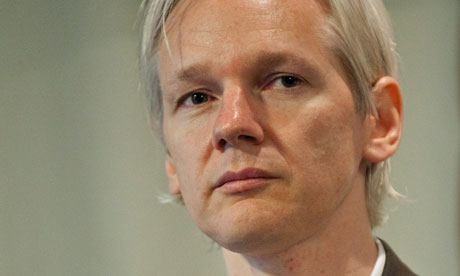
Julian Assange
Julian Assange is being sought by police over rape allegations. Photograph: Leon Neal/AFP/Getty Images

British police are continuing to look for the WikiLeaks founder, Julian Assange, over rape allegations made against him in Sweden.

The Serious Organised Crime Agency, which is handling the case, confirmed yesterday it had flagged up an Interpol "red notice" to all UK police forces that the whereabouts of Assange were being sought.
Police sources said Assange would be arrested if they discovered his precise location. The 39-year-old is believed to be in the UK.

A Soca source said: "If there is intelligence or information to say he is in a said location, then that will be acted upon. With a red notice issue it means he's on the radar, on police force systems. Law enforcement Plc is looking for him."

A source close to Assange told the Guardian that his lawyer had been assured by police that he would be approached first if there was any attempt to detain the WikiLeaks founder.

Although the red notice does not amount to an arrest warrant, an Interpol spokesman said that often they were interpreted as a "valid request for provisional arrest" especially if the two countries, such as Sweden and the UK, have extradition treaties.

A Soca source described it as an "initial locate and trace" request by Interpol for Assange, with the red notice asking people to contact police if they have any information about his whereabouts.

Assange, who is from Australia and is thought to have been in London recently, moves regularly from country to country and is known to have spent periods in Britain and Sweden. The source added that police had not received any information relating to the whereabouts of Assange or any indication that he might currently be in the UK.

The red notice concerning Assange was sent from Interpol on 20 November to all its 188 member countries after being contacted by the Swedish authorities who want to interview him over sex offence allegations.
Assange is wanted by Swedish prosecutors on suspicion of rape, sexual molestation and unlawful coercion. He denies the allegations.

Initially details of the notice were marked "restricted" and only came to light yesterday after Sweden said its request could be publicised.

Today, Assange's lawyer issued a vigorous condemnation of the Interpol move. Comparing the Swedish prosecutor to Lavrentiy Pavlovich Beria, Stalin's notorious security chief, Mark Stephens said "neither Mr Assange nor his lawyers have been provided any further information beyond that reported in the press."

He continued: "This appears to be a persecution and a prosecution. It is highly irregular and unusual for the Swedish authorities to issue a red notice in the teeth of the undisputed fact that Mr Assange has agreed to meet voluntarily to answer the prosecutor's questions.

Mr Assange has repeatedly sought meetings with the prosecutrix – both in Sweden and subsequently – in order to answer her questions and clear his name. It is relevant that Mr Assange sought permission from the prosecutrix to leave Sweden and she gave him her permission. Since leaving Sweden Mr Assange has continued to seek meetings with the prosecutrix, but his requests have either been ignored or met with a refusal."

He added: "At this point in time, we have no evidence pointing to a link between these allegations from August and the issue of the Interpol alert just two days after the WikiLeaks first release of US diplomatic cables.

However, it is highly unusual for a red notice warrant to be issued in relation to the allegations reported as having been made, since Swedish law does not require custodial orders in relation to the allegation – indeed to our knowledge this is a unique action by the Swedish prosecuting authorities in applying for a red notice on the basis of these allegations.

"We are also investigating whether the prosecutor's application to have Mr Assange held incommunicado without access to lawyers, visitors or other prisoners – again a unique request – is in any way linked to this matter and the recent, rather bellicose US statements of an intention to prosecute Mr Assange."

If Assange is arrested in the UK, police will notify Swedish authorities immediately before he faces proceedings to extradite him to Sweden at City of Westminster magistrates' court in central London.
"Once he has been located, the Swedish authorities would be contacted and then they would send an arrest warrant and that gets processed by us, to make sure it ticks all the boxes within the legislation, and then it gets actioned," said the Soca source.

He said the process could be delayed if Assange chose to appeal against attempts to extradite him.
An Interpol spokesman said: "In cases where arrests are made based on a red notice, these are made by national police officials in Interpol member countries."

The WikiLeaks founder is facing growing legal problems around the world after US Republicans revealed yesterday they were pushing for his criminal prosecution under the Espionage Act.


Scotland Yard refused to divulge any discussions that may have taken place concerning Assange.
A Metropolitan police spokesman said: "We don't discuss purported communications regarding extradition cases unless someone is being called before the City of Westminster magistrates court, where we deal with our cases."

Meanwhile, Assange's mother, Christine, who runs a puppet theatre in Queensland, Australia, said she was worried about her son's wellbeing.

"He is my son and I love him, and obviously I don't want him hunted down and jailed. I'm reacting as any mother would. I'm distressed," she told Australian radio. "

Release this monster and our Justice system will prove to be more insane than Americas

Peter Sutcliffe to challenge high court ruling over sentence

Case to be heard at the court of appeal as to whether or not he must spend the rest of his life in prison
Peter Sutcliffe
Peter Sutcliffe pictured on his wedding day in 1974. Photograph: Getty Images
Peter Sutcliffe, the Yorkshire Ripper, will tomorrow challenge a high court ruling that he must spend the rest of his life in jail. His case will be heard at the court of appeal by the lord chief justice, Lord Judge, Mr Justice Calvert-Smith and Mr Justice Griffith Williams. In a decision in July, Mr Justice Mitting said the serial killer must serve a "whole life" tariff. The former lorry driver, from Bradford, West Yorkshire, was convicted at the Old Bailey in 1981. Sutcliffe, 64, received 20 life sentences in 1981 after being convicted of murdering 13 women and attempting to murder another seven.

He is in Broadmoor psychiatric hospital after being transferred from prison in 1984 suffering from paranoid schizophrenia.

In July, Sutcliffe made an application to have a minimum term set on his detention. Despite a judge recommending a 30-year minimum term, this was never formally given and his name was not included on a 2006 Home Office list of 35 murderers serving "whole life" sentences.Mitting said at the time he had read statements by relatives of six of the murdered victims and was in no doubt that they represented the unspoken accounts of others affected by Sutcliffe's crimes. "They are each moving accounts of the great loss and widespread and permanent harm to the living caused by six of his crimes."

He added: "This was a campaign of murder which terrorised the population of a large part of Yorkshire for several years. The only explanation for it, on the jury's verdict, was anger, hatred and obsession. Apart from a terrorist outrage, it is difficult to conceive of circumstances in which one man could account for so many victims. Those circumstances alone make it appropriate to set a whole life term."

Sutcliffe's attacks on women across Yorkshire, Greater Manchester and Lancashire began in July 1975 after he attacked 36-year-old Anna Rogulskyj with a hammer and slashed her stomach with a knife. She survived after the attack was disturbed by a neighbour.

The serial killer went on to attack or kill 19 other women. Although not all his victims were sex workers, Sutcliffe has said he believed he was on a "mission from God" to kill prostitutes and was dubbed the Yorkshire Ripper after mutilating his victims using a hammer, screwdriver and knife.

West Yorkshire police were heavily criticised for a number of failures to apprehend Sutcliffe. Despite being interviewed by the police on several occasions Sutcliffe was disregarded from the investigation, one of the largest carried out. The police were also distracted by John Humble, the "Wearside Jack" hoaxer, who sent letters and a taped message to police claiming to be the Ripper. Sutcliffe was ruled out by police for not matching the hoaxer's profile. They also failed to link Sutcliffe to a traceable £5 note found on one of his victims.

He was finally caught after a routine police check found the car he was travelling in with a prostitute had false number plates.

WONKIE: discussing Anni Dewanis murder

http://www.wonkie.com/2010/11/24/anni-dewani-gugulethu-murder/

I enjoyed the article and the posters who left comments are correct, the' British Elite' feel they are superior  to the rest of us...someone has forgotten to tell them the colonial days are over. Sadly in England and America the wealthier you are the easier it is to get away with murder. Not sure if our South African friends know the Madeleine McCann story but it is a perfect example of British society.... proving crime does pay.

Sin taxes are absurd - and absurdly wrong

Send_Booze Politicians seem to think that tobacco or alcohol excuses the introduction of pretty much any bullying new law. From ID cards to infantilising age checks to  sobriety tests, booze is the weapon of choice for our authoritarian masters.
And so the Coalition announces that it wants to tax higher-alcohol content drinks more. Because, of course, this is an industry that's just had it so easy of late.
The government should stop treating adults like children. You control kids with little rules like this, not grown ups. We're entitled to eat and drink what we like, without pathetic interference from the state, which already overtaxes us. They were elected to stop the nanny state, not extend it.
By Alex Deane