Wednesday, December 1, 2010

American democracy...do as I say and not as I do.

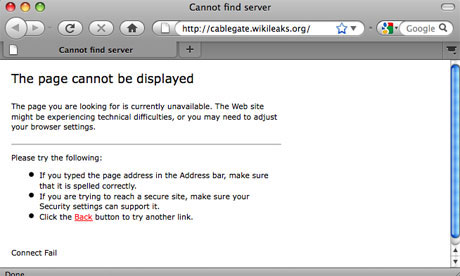
WikiLeaks website pulled by Amazon after US homeland security pressure

Site hosting leaked US embassy cables is ousted from American servers as senator calls for boycott of WikiLeaks by companies
WikiLeaks's website cablegate.wikileaks.org, which was hosted by Amazon
WikiLeaks's website cablegate.wikileaks.org, which was hosted by Amazon.

The United States struck its first blow against WikiLeaks today after Amazon.com pulled the plug on hosting the whistleblowing website in an apparent reaction to heavy political pressure.

The main website and a sub-site devoted to the diplomatic documents were unavailable from the US and Europe on Wednesday, as Amazon servers refused to acknowledge requests for data.

The plug was pulled as the influential senator and chairman of the homeland security committee Joe Lieberman called for a boycott of the site by US companies.

"(Amazon's) decision to cut off WikiLeaks now is the right decision and should set the standard for other companies WikiLeaks is using to distribute its illegally seized material," he said in a statement. "I call on any other company or organization that is hosting WikiLeaks to immediately terminate its relationship with them."

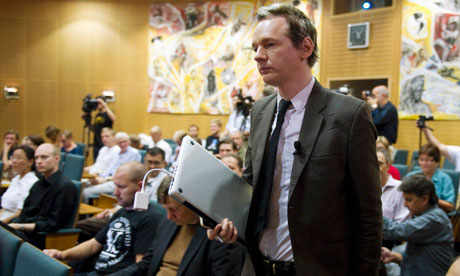
The development came amid increasingly angry and polarised political opinion in America over WikiLeaks, with some conservatives calling for the organisation's founder, Julian Assange, to be executed as a spy.
Availability of his website has been patchy since Sunday, when it started to come under a series of internet-based attacks by unknown hackers. WikiLeaks dealt with the attacks in part by moving to servers run by Amazon Web Services, which is self-service.

Amazon.com would not comment on its relationship with WikiLeaks or whether it forced the site to leave. Messages seeking comment from WikiLeaks were not immediately returned.

The fury building up among rightwingers in the US, ranging from the potential Republican presidential candidate Mike Huckabee to conservative blog sites such as Red State, contrasts with a measured response from the Obama administration.

The White House, the state department and the Pentagon continued to denounce the leaks, describing them as "despicable". But senior administration officials, with a sense of weary resignation, also called on people to put the leaks into context and insisted they had not done serious damage to US relations.

The White House press secretary, Robert Gibbs, interviewed on television, shrugged aside as "ridiculous" a call by Assange, interviewed by Time magazine, via Skype from an undisclosed location, for the resignation of the secretary of state, Hillary Clinton, over an order to spy on the United Nations
.
"I'm not entirely sure why we care about the opinion of one guy with one website," Gibbs said. "Our foreign policy and the interests of this country are far stronger than his one website."

John Kerry, the Democratic head of the Senate foreign relations committee, on Sunday denounced the leaks but he sounded more sanguine at an event in Washington on Tuesday night.

He said there was a "silver lining" in that it was now clear where everyone stood on Iran. "Things that I have heard from the mouths of King Abdullah [of Saudi Arabia] and Hosni Mubarak [Egyptian president] and others are now quite public," Kerry said. He went on to say there was a "consensus on Iran".

But others, particularly rightwingers, are seeking retribution, with Assange as the prime target. Legal experts in the US were divided over whether the US could successfully prosecute Assange under the 1917 Espionage Act. Sceptics said that the US protections for journalists would make such a prosecution difficult and also cited pragmatic issues, such as the difficulty of extraditing Assange.

Huckabee, who was among the contenders for the Republican presidential nomination in 2008 and is likely to stand again in 2012, told the Politico website: "Whoever in our government leaked that information is guilty of treason, and I think anything less than execution is too kind a penalty."

His later comments suggest he had in mind Bradley Manning, the US private in Iraq who is suspected of leaking the information and is under arrest in Virginia, rather than Assange.

Another potential Republican candidate for the presidency, Sarah Palin, had earlier called for Assange to be hunted down.

Conservative blogsites and commentators are full of ire directed at Assange, and criticism of the Obama administration for its seeming inability to do anything about it.

Typical is a blog by lexington_concord on Red State, a popular rightwing site, in which the writers says Assange is a spy.

"Under the traditional rules of engagement he is thus subject to summary execution and my preferred course of action would [be] for Assange to find a small calibre round in the back of his head."

The attorney general, Eric Holder, earlier this week hinted at legal action but did not clarify whether his words were aimed at Manning or Assange. A department of justice spokeswoman failed to clarify this yesterday: "He [Holder] said the department would pursue those to be found violating the law." She added she was not commenting on the scope or direction of the investigation.

The Pentagon press secretary, Geoff Morrell, interviewed on Fox, suggested Holder's reference had been to Assange. Asked why the US was not mounting a cyberattack on WikiLeaks, Morrell said the disclosures were awkward and embarrassing but these were not sufficient grounds for offensive action.

He referred back to comments made the previous day by the defence secretary, Robert Gates, who attempted to put the leaks in perspective. Gates said: "Is this embarrassing? Yes. Is it awkward? Yes. Consequences for US foreign policy: I think fairly modest."

A former defence secretary under Bill Clinton, William Cohen, echoed Gates, saying that the information was probably not fatal. Cohen joined the chorus calling for Assange to be prosecuted, provided he can be found.
"He may be hiding in a cave with Osama bin Laden. We don't know where he is but I am confident we will find him in the near future. He will be arrested and brought to justice," Cohen said.

Ruth Wedgwood, a former federal prosecutor and Johns Hopkins law professor, said, in an email exchange, that Assange, an Australian, could prosecuted. "A person who steals or knowingly receives and transmits protected national security information is not exempt from US criminal law merely because he is foreigner. The Espionage Act has been used to prosecute foreign defendants as well as Americans.

"Freedom of the press and the First Amendment would not shelter someone who deliberately steals tens of thousands of closely-held communications containing national security and defence information, and wantonly publishes them to both friends and foes alike, with heedless disregard for the damage that is caused."
Floyd Abrams, the constitutional expert who has argued before the supreme court on the First Amendment, which enshrines press freedom, was more sceptical. He said the government had a plausible case under the Espionage Act, which is phrased very broadly.

The government had looked in 1971 at prosecution of the New York Times over the Pentagon Papers leak and decided against. "Here I think it is a closer call. The documents are much more current and they have the potential to do more harm, for example the reference to the King of Saudi Arabia urging the US to bomb Iran," Abrams said in an phone interview.

"I think for the government it must be a close call. On the one hand, the leaks are of such magnitude and involve topics of such sensitivity and currency, it must be tempting to consider prosecution but on the other hand the government would be forced to address difficult and sensitive issues of whether a journalist could be accused of violating the law."

He added that Assange was not a journalist but does some of the things associated with journalism.
Another legal expert, Scott Silliman, a professor at the Duke University School of Law, said: "A US prosecution of Assange would be possible, but it would be fraught with problems for the government. The applicable statute, section 793(e) of the Espionage Act, is somewhat ambiguous when dealing with a case of this type where the accused claims to be part of or allied with the media. Further, there will probably be difficulties in having Assange extradited to the United States for trial."


WikiLeaks website pulled by Amazon after US homeland security pressure

Site hosting leaked US embassy cables is ousted from American servers as senator calls for boycott of WikiLeaks by companies
WikiLeaks's website cablegate.wikileaks.org, which was hosted by Amazon
WikiLeaks's website cablegate.wikileaks.org, which was hosted by Amazon.

The United States struck its first blow against WikiLeaks today after Amazon.com pulled the plug on hosting the whistleblowing website in an apparent reaction to heavy political pressure.
The main website and a sub-site devoted to the diplomatic documents were unavailable from the US and Europe on Wednesday, as Amazon servers refused to acknowledge requests for data.
The plug was pulled as the influential senator and chairman of the homeland security committee Joe Lieberman called for a boycott of the site by US companies.
"(Amazon's) decision to cut off WikiLeaks now is the right decision and should set the standard for other companies WikiLeaks is using to distribute its illegally seized material," he said in a statement. "I call on any other company or organization that is hosting WikiLeaks to immediately terminate its relationship with them."
The development came amid increasingly angry and polarised political opinion in America over WikiLeaks, with some conservatives calling for the organisation's founder, Julian Assange, to be executed as a spy.
Availability of his website has been patchy since Sunday, when it started to come under a series of internet-based attacks by unknown hackers. WikiLeaks dealt with the attacks in part by moving to servers run by Amazon Web Services, which is self-service.
Amazon.com would not comment on its relationship with WikiLeaks or whether it forced the site to leave. Messages seeking comment from WikiLeaks were not immediately returned.
The fury building up among rightwingers in the US, ranging from the potential Republican presidential candidate Mike Huckabee to conservative blog sites such as Red State, contrasts with a measured response from the Obama administration.
The White House, the state department and the Pentagon continued to denounce the leaks, describing them as "despicable". But senior administration officials, with a sense of weary resignation, also called on people to put the leaks into context and insisted they had not done serious damage to US relations.
The White House press secretary, Robert Gibbs, interviewed on television, shrugged aside as "ridiculous" a call by Assange, interviewed by Time magazine, via Skype from an undisclosed location, for the resignation of the secretary of state, Hillary Clinton, over an order to spy on the United Nations.
"I'm not entirely sure why we care about the opinion of one guy with one website," Gibbs said. "Our foreign policy and the interests of this country are far stronger than his one website."
John Kerry, the Democratic head of the Senate foreign relations committee, on Sunday denounced the leaks but he sounded more sanguine at an event in Washington on Tuesday night.
He said there was a "silver lining" in that it was now clear where everyone stood on Iran. "Things that I have heard from the mouths of King Abdullah [of Saudi Arabia] and Hosni Mubarak [Egyptian president] and others are now quite public," Kerry said. He went on to say there was a "consensus on Iran".
But others, particularly rightwingers, are seeking retribution, with Assange as the prime target. Legal experts in the US were divided over whether the US could successfully prosecute Assange under the 1917 Espionage Act. Sceptics said that the US protections for journalists would make such a prosecution difficult and also cited pragmatic issues, such as the difficulty of extraditing Assange.
Huckabee, who was among the contenders for the Republican presidential nomination in 2008 and is likely to stand again in 2012, told the Politico website: "Whoever in our government leaked that information is guilty of treason, and I think anything less than execution is too kind a penalty."
His later comments suggest he had in mind Bradley Manning, the US private in Iraq who is suspected of leaking the information and is under arrest in Virginia, rather than Assange.
Another potential Republican candidate for the presidency, Sarah Palin, had earlier called for Assange to be hunted down.
Conservative blogsites and commentators are full of ire directed at Assange, and criticism of the Obama administration for its seeming inability to do anything about it.
Typical is a blog by lexington_concord on Red State, a popular rightwing site, in which the writers says Assange is a spy.
"Under the traditional rules of engagement he is thus subject to summary execution and my preferred course of action would [be] for Assange to find a small calibre round in the back of his head."
The attorney general, Eric Holder, earlier this week hinted at legal action but did not clarify whether his words were aimed at Manning or Assange. A department of justice spokeswoman failed to clarify this yesterday: "He [Holder] said the department would pursue those to be found violating the law." She added she was not commenting on the scope or direction of the investigation.
The Pentagon press secretary, Geoff Morrell, interviewed on Fox, suggested Holder's reference had been to Assange. Asked why the US was not mounting a cyberattack on WikiLeaks, Morrell said the disclosures were awkward and embarrassing but these were not sufficient grounds for offensive action.
He referred back to comments made the previous day by the defence secretary, Robert Gates, who attempted to put the leaks in perspective. Gates said: "Is this embarrassing? Yes. Is it awkward? Yes. Consequences for US foreign policy: I think fairly modest."
A former defence secretary under Bill Clinton, William Cohen, echoed Gates, saying that the information was probably not fatal. Cohen joined the chorus calling for Assange to be prosecuted, provided he can be found.
"He may be hiding in a cave with Osama bin Laden. We don't know where he is but I am confident we will find him in the near future. He will be arrested and brought to justice," Cohen said.
Ruth Wedgwood, a former federal prosecutor and Johns Hopkins law professor, said, in an email exchange, that Assange, an Australian, could prosecuted. "A person who steals or knowingly receives and transmits protected national security information is not exempt from US criminal law merely because he is foreigner. The Espionage Act has been used to prosecute foreign defendants as well as Americans.
"Freedom of the press and the First Amendment would not shelter someone who deliberately steals tens of thousands of closely-held communications containing national security and defence information, and wantonly publishes them to both friends and foes alike, with heedless disregard for the damage that is caused."
Floyd Abrams, the constitutional expert who has argued before the supreme court on the First Amendment, which enshrines press freedom, was more sceptical. He said the government had a plausible case under the Espionage Act, which is phrased very broadly.
The government had looked in 1971 at prosecution of the New York Times over the Pentagon Papers leak and decided against. "Here I think it is a closer call. The documents are much more current and they have the potential to do more harm, for example the reference to the King of Saudi Arabia urging the US to bomb Iran," Abrams said in an phone interview.
"I think for the government it must be a close call. On the one hand, the leaks are of such magnitude and involve topics of such sensitivity and currency, it must be tempting to consider prosecution but on the other hand the government would be forced to address difficult and sensitive issues of whether a journalist could be accused of violating the law."
He added that Assange was not a journalist but does some of the things associated with journalism.
Another legal expert, Scott Silliman, a professor at the Duke University School of Law, said: "A US prosecution of Assange would be possible, but it would be fraught with problems for the government. The applicable statute, section 793(e) of the Espionage Act, is somewhat ambiguous when dealing with a case of this type where the accused claims to be part of or allied with the media. Further, there will probably be difficulties in having Assange extradited to the United States for trial."


Comments in chronological order (Total 43 comments)

Post a comment
  • This symbol indicates that that person is The Guardian's staffStaff
  • This symbol indicates that that person is a contributorContributor

  • Gelion Gelion

    1 December 2010 8:03PM
    No surprises there - I hope he moves to somewhere neutral and it can carry on.
    Lots of embarrassing stuff for everyone. It's most hilarious.

  • BitterBunny BitterBunny

    1 December 2010 8:06PM
    There is a piece of minor irony here re: Amazon - this is the company that yanked 1984 off their customers kindles and had all kinds of fun trying to spin its way out of that one.

  • mswinkle mswinkle

    1 December 2010 8:07PM
    "Amazon.co m ceases hosting services for WikiLeaks website -Senator Lieberman" and "DHS says Amazon has agreed to stop hosting WikiLeaks. " Game Over They will start shutting down any site that speaks up against them.
    email/writ e to amazon tell them you will stop using their site. HIt them HARD in their pockets and let's see if they will defy Big Sis. Come on we can do it. let Amazon know they will LOSE LOTS OF MONEY. If we don't do this now they will be shutting down so many sites we will no longer have the POWER They will start shutting down any site that speaks up against them. If we do NOT stand up and FIGHT back now TPTB will have won.

  • teaandchocolate teaandchocolate

    1 December 2010 8:07PM
    Another potential Republican candidate for the presidency, Sarah Palin, had earlier called for Assange to be hunted down.
    The fury building up among rightwingers in the US, ranging from the potential Republican presidential candidate Mike Huckabee
    For the those quotes only, it would be worth keeping Wikileaks online. Hoppin' mad yankees, it can only be good. Anyone offering?
    For goodness sake America, in Hollywood America saves the world single handed, stops bombs with its teeth and fights aliens. Surely you aren't scared of an Australian with white(ish) hair?

  • nadirnwo nadirnwo

    1 December 2010 8:09PM
    Great! Another example offered to China, Mayanmar, Pakistan, Gulf States and the likes on a silver platter of western governments in regards to free speech. The next time a third world country gets lectured on allowing free speech, guess what they will retaliate with - See above

  • Dreagon Dreagon

    1 December 2010 8:10PM
    Actually, Assunge is providing one useful lesson. That it really doesn't matter who is in office as far as foreign policy is concerned, as they have to deal with the same realities that faced their predecessors. Whether it's Bush or Obama, both were elected to act in the interests of the superpower they nominally run.

  • tigi tigi

    1 December 2010 8:10PM
    History will show this to be a benign event. Julian is not exposing sensitive material, he's simply letting light shine on the crap that all governments engage in.

  • vertical vertical

    1 December 2010 8:11PM
    Amazon lose nerve, will lose (if not haemorrhage) customers over this.
    Let's hope Jobs takes time off from his deal with, er, Murdoch to support this humanitarian movement. Or Google? Or the Chinese government?
    Enlightenment - a breeding ground for terrorism, obviously. Let's fight it.

  • legaff legaff

    1 December 2010 8:11PM
    Julian Assange must be protected at all costs.
    Sites like wikileaks are the reason why the internet and technology must be embraced.
    Once again, The United States of America show that the world they can't play fair.

  • Westmorlandia Westmorlandia

    1 December 2010 8:11PM
    Not 100% convinced by the Wikileaks philosophy (broadly, that all secrets are bad). But I don't see how this is a principled response from a democratic government.

  • TeaJunkie TeaJunkie

    1 December 2010 8:11PM
    The White House press secretary, Robert Gibbs, interviewed on television, shrugged aside as "ridiculous" a call by Assange, interviewed by Time magazine, via Skype from an undisclosed location, for the resignation of the secretary of state, Hillary Clinton, over an order to spy on the United Nations.
    "I'm not entirely sure why we care about the opinion of one guy with one website," Gibbs said. "Our foreign policy and the interests of this country are far stronger than his one website."

    Gibbs could do well to remember that 'pride comes before a fall'.

  • ifshespins ifshespins

    1 December 2010 8:12PM
    Typical is a blog by lexington_concord on Red State, a popular rightwing site, in which the writers says Assange is a spy.
    "Under the traditional rules of engagement he is thus subject to summary execution and my preferred course of action would [be] for Assange to find a small calibre round in the back of his head."
    At first I thought this was a joke.. Sadly mistaken.

  • Ind3pendant Ind3pendant

    1 December 2010 8:12PM
    What happens now then?
    Anyone have any ideas as to how we will get access to the files again?
    Is it time for the Insurance Torrent password to go live?

  • Expialadocious Expialadocious

    1 December 2010 8:12PM
    Sarah Palin said Julian Assange should be hunted down like Osama Bin Laden.
    Good, that means Assange is safe for at least another decade.
    Long live the Wikileaks!

  • Gelion Gelion

    1 December 2010 8:12PM
    @amnesiac88
    "This is getting silly now. School yard tactics courtesy of the land of the free."
    Disregarding my comment at the top of the page, I want to point out @amnesiac88 that the US is in NO WAY the Land of the Free - what it is is the "Land of the Corporation influencing laws and military industrial complex" - free speech in the US may part of the constitution but it is not effective and it is also prone to revision by the right wing Republicans to control society.
    We probably have more "Freedom of speech" in post 1980s Thatcherite UK, over the last 30 years. Which considering her assault on the unions, etc, is surprising.
    There are no surprises that this has happened - and I hope that the Guardian can still publish.

  • BobHughes BobHughes

    1 December 2010 8:12PM
    This is hardly going to be an issue for Wikileaks. If recent history is anything to go by, I would imagine that the database will be mirrored on a number of sites within 24 hours.

  • timjsharpe timjsharpe

    1 December 2010 8:13PM
    Not surprised. Amazon must have been under immense pressure, though it may influence those seeking to use a cloud hosting provider in the future as they might like their web presence not to be subject to the US government's opinion on their right to operate.
    More concerning is the right wing vitriol, particularly those calling for execution of either Assange or Manning. I can't see the Obama administration indulging these calls but it really does weaken any attempts to reason with states that use execution more routinely.

  • mcyigra3 mcyigra3

    1 December 2010 8:13PM
    what you thought you lived in a democracy?
    what you thought you could say what you liked?
    what you thought you could do what you liked?
    what you think we dont control you?
    what you think we dont tell you what you should think, do, and how you should live?
    what you think we will not kill you if we want?
    what the hell do you think is going on?
    what no suprise?

  • MidEnglandAce MidEnglandAce

    1 December 2010 8:13PM
    Democracy, freedom, liberty & transparency, US dominated west style.
    Life, under the liberal democracy's of the west, seems to be becoming less democratic and more authoritarian by the day.

  • BlairM BlairM

    1 December 2010 8:14PM
    Palin is correct. Assange has blood on his hands. His leaking of confidential information is a direct security threat to the United States, and to many other countries and their governments.
    I hope he does get a bullet in the back of his head, the least that could happen to atone for the lives lost in Kenya especially.

  • Arveyate Arveyate

    1 December 2010 8:14PM
    Land of the free: free to torture, free to limit access to websites.
    It is odd, isn't it. As our freedoms are restricted we are told that if we haven't got anything to hide, what have we got to worry about.
    They don't like it up 'em, do they.

  • Salongvaenster Salongvaenster

    1 December 2010 8:14PM
    No more shopping from Amazon for me then!
    If you care about freedom and the right to expose wrongdoing, wherever it is carried out, you too should boycott Amazon - one thing capitalists do care about is a drop in their profits.

Murdered Hollywood publicist was gunned down by 'expert marksman', coroner reveals

By Daily Mail Reporter
Last updated at 6:58 PM on 1st December 2010

  • Coroner: Injuries consistent with a 'professional hit'
  • Ronni Chasen shot five times in the chest
  • She managed to drive for quarter of a mile after she was shot
  • Police still baffled by lack of motive for the killing
Popular: Ronni Chasen was murdered after being shot five times in the chest while driving back from a film premiere
Hollywood publicist Ronni Chasen was shot dead by an expert marksman, it was revealed today.
An initial coroner's report showed the movie industry stalwart's injuries were consistent with a professional 'hit'.
Miss Chasen, 64, was shot five times in the chest in the early hours of November 16th in Beverly Hills, shortly after leaving the premiere of Burlesque.
The coroner said the nature of the famed publicist's injuries were consistent with being targeted by a professional gunman.
The report said:'There were three apparent gunshot wounds to the right side breast/chest area. There were two apparent gunshot wounds to the right shoulder.
'There was an apparent gunshot wound to the right upper back and the left upper back.
'One bullet was recovered from her back while at the hospital and is possibly a 9mm hollow point.'
Detectives confirmed they are looking for a skilled marksman as part of their murder probe.
They believe the gunman fired from a SUV or truck that pulled up alongside Miss Chasen's BMW as she stopped on Sunset Boulevard.
The report added: 'After being struck by gunfire, she then made a left turn and drove for approximately a quarter mile before she crashed her car into a pole.'
Former LA detective Gill Carillo told ABC News: 'Normally they turn the gun sideways and this is something that was done with some skill.
'I carried a gun for 38 years and had to fire it quarterly. I don't think I could shoot and hit that mass like that.'
Police could find no shell casings and only the car's right-side passenger seats and windows were damaged.
Miss Chasen's death has prompted a swirl of theories as to who might have wanted to kill the popular publicist.
Footage of her driving a car that was not hers 19 days before she was gunned down has only added to the intrigue as conspiracy theories abound about her death.
The film, snapped by a private investigator who was asked to record all the comings and going of the building where Miss Chasen was living, for an unrelated purpose, shows her driving an unidentified vehicle.


While police found Miss Chasen's black E350 Mercedes Benz crashed into a lamp post at the scene of her death, the car she is seen driving just weeks before the killing was not hers.
Police are now studying the video to see if it will shed any light on the mysterious killing.
They have already dismissed the possibilities that Miss Chasen, on her way back from a screening of Burlesque, was gunned down in a road rage incident or that it was a car-jacking gone wrong.
Crash: The car that Miss Chasen was driving had careered in to a lamp pole
The police theory focuses on shots being fired from another car that pulled up next to the passenger side of Miss Chasen's car at around 12:30am on November 16.
It is believed these shots are what shattered Chasen's passenger side window, but police have ruled out a random sniper shooting.
Other theories from inside Beverly Hills include the following:
  • Miss Chasen had a close friend or family member who had accumulated gambling debts of over £300,000 and the creditors were chasing her for money
  • A Russian mob, who had invested in one of the films she had helped produced and were disappointed about their return, killed her
  • Miss Chasen was shot because of an art deal gone wrong
  • Someone was jealous of her successful Oscar campaigns

Friends in high places: Miss Chasen pictured with Jeff Bridges at the Oscars earlier this year (left) while actor Elliott Gould attended her funeral
Police spokesman Lieutenant Tony Lee told the New York Post: 'People are coming out with all types of theories. But we will not rule out anything until the perpetrator is found.'

Miss Chasen's funeral was held last month and mourners included industry colleagues and Hollywood stars, including actors Michael Douglas and Elliott Gould.


Read more: http://www.dailymail.co.uk/news/article-1334765/Coroners-report-confirms-Ronni-Chasen-died-gunshot-injuries-consistent-professional-hit.html#ixzz16tP1Mp8k

WikiLeaks cables: Diplomats are not intelligence assets – state department

Allegations that US diplomats were asked to collect data on senior UN members dominated yesterday's press briefing
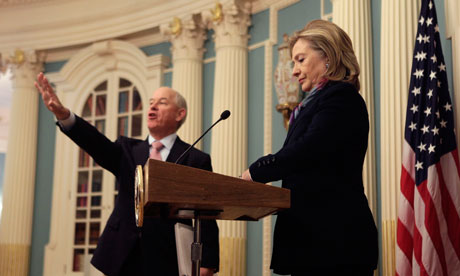
PJ Crowley and US Secretary of State Hillary Clinton at the US press briefing
PJ Crowley and US Secretary of State Hillary Clinton at the US press briefing. Photograph: Yuri Gripas/Reuters
On Monday the Guardian reported how a leaked diplomatic cable revealed that US diplomats were asked to collect information – including credit card details, frequent flyer numbers and biometric data – on senior members of the United Nations. The allegations from the massive leak of embassy cables dominated yesterday's state department press briefing. This is an extract of the exchanges with state department spokesman PJ Crowley.

QUESTION: And, PJ, you're probably aware that in the blogosphere, there are a few people who are now saying the secretary should resign over WikiLeaks, and they're saying not only that –

CROWLEY: And why would that be?

QUESTION: Well, I'm going to give the reasons to you. Essentially, one would be just the fact that they came … that these were leaked, but more importantly, they're zeroing in back again on the United Nations and that directive, which apparently came from the office of the secretary, telling diplomats to collect this information.

CROWLEY: Well, again, let –

QUESTION: Can you set us right on what –

CROWLEY: Let me be clear on that. I've touched on that, but let me be as clear as I can. The secretary has said it. Ambassador Rice has said it. I've said it. Diplomats are diplomats. That is their job. Diplomats are not intelligence assets. The – I'm reluctant to talk about any particular document, but just because – as I said, by tradition, any document that leaves the department of state has the secretary of state's name on it. She is responsible, but she was not the author of that particular document, and the contents of that came from outside the department of state. We are … diplomats have a difficult job. They are … it is useful for them to know what is of interest across the government, but this doesn't change the day-to-day duties of any diplomat anywhere.

QUESTION: PJ, just one clarification, because, again, if you look at those … the articles that are being written, it's being described as not only information, but biometric data. And in fact, one of the articles I read said DNA. It was as detailed as that.

CROWLEY: Look, Jill, there are entities within our government that have certain responsibilities. It is – it's one thing for that community to provide a wish list across the government that helps people understand what is useful. It takes a leap of faith to say that fundamentally changes the day-to-day responsibilities of our diplomats. It doesn't.

Our diplomats are diplomats. Our diplomats are not intelligence assets. They can collect information. If they collect information that is useful, we share it across the government, as we've been talking about with respect to documents generated by the department of state. But we – please do not infer from one document that this fundamentally changes the role – nothing has changed based on a document that has been issued through the department for a number of years.

QUESTION: PJ, just a quick clarification. You said the contents of the document came from outside the department of state? Did you say that?

CROWLEY: I did.

QUESTION: What does that mean?

QUESTION: What does that mean, yeah?

CROWLEY: Again, I'm not going to talk about a particular document.

QUESTION: Well, then PJ, let me just ask you –

CROWLEY: Look, guys, guys, I've said all I'm going to say about this.

QUESTION: Just one more clarification. You mentioned a wishlist. In other words, are you saying that a certain agency issued a wish list of what diplomats should collect and that those diplomats are free to do as much or as little as possible in collecting that information?

CROWLEY: Diplomats are diplomats and their job is to interact with people, gather information, gain a perspective of events around the world, and report those findings in a way that helps inform our policies and inform our actions. They are not intelligence assets. It can be useful for a diplomat to understand from Washington – you have a diplomat out in any place in the world, hey, there are issues that are of particular interest to the United States government. If you come across information that might be relevant to these issues, let us know. That's … those are … that is something that diplomats actually do every day. But one particular cable does not turn a diplomat into an intelligence asset.

QUESTION: But PJ, how can you say that diplomats are diplomats when we're talking about collecting DNA data? You want to know how many times these UN officials are flying, you want to know the credit card details. Can you at least acknowledge that after 9/11 there is a blurring of lines between diplomacy and espionage, that the role of –

CROWLEY: No, there –

QUESTION: – a diplomat has expanded?

CROWLEY: I will specifically reject that idea. Nothing in the role of a diplomat at the state department has changed because of any one document or any one event. What we do here at the state department, we do – we've done it the same way for a number of years, and our role in helping to formulate and execute the foreign policy of the United States did not change on 9/11.

QUESTION: So you always collected DNA data? Nothing changed?

CROWLEY: Again, I'm … nothing in any document that is allegedly in the tranche of WikiLeaks – or in the possession of WikiLeaks – changed the role of any diplomat anywhere in the world.

WikiLeaks cables: 'Nicolas Sarkozy thin-skinned and authoritarian'

US embassy cables detail how staff and ministers fear ire of French president and warn of impact of personal lifestyle
Nicolas Sarkozy is described in the US embassy cables as 'brilliant, impatient, hard to predict'
Nicolas Sarkozy is described in the US embassy cables as 'brilliant, impatient, undiplomatic, hard to predict, charming, innovative, and summit-prone'. Photograph: Eric Feferberg/AFP/Getty Images
Nicolas Sarkozy's advisers were so afraid of sparking his anger that they reportedly diverted his plane to avoid him seeing the Eiffel Tower lit up in the colours of the Turkish flag, according to a confidential note from the US ambassador in Paris.
A series of classified US memos depict the French president as a self-absorbed, thin-skinned, erratic character who tyrannises his ministers and staff. He is portrayed as undiplomatic, hyperactive, sometimes uncouth and in need of careful handling, despite being the most pro-US French president since the second world war and a brilliant political tactician.
A confidential memo to the US secretary of state, Hillary Clinton, from ambassador Charles Rivkin in December 2009, said of Sarkozy: "Elysée contacts have reported to us the great lengths they will go to avoid disagreeing with him or provoking his displeasure – even recently reportedly rerouting the president's plane to avoid his seeing the Eiffel Tower lit up in Turkey's colours on the visit of PM [Recep Tayyip] Erdogan." Paris's Socialist mayor had turned the tower red and white in Erdogan's honour. Sarkozy is fiercely opposed to Turkish membership of the EU.
The same memo worried that midway through Sarkozy's five-year term, his staff were unwilling "to point out when the emperor is less than fully dressed". The president "has few restraints – political, personal or ideological – to act as a brake on his global ambitions". He promoted those "prepared to adopt his policies" and marginalised those "with a diverse view", demoting ministers for disagreeing with him.
The memos analysed Sarkozy's divorce, whirlwind remarriage and flashy lifestyle. They showed a French leader keen to be the personal friend of George W Bush and Barack Obama and end what one Sarkozy adviser deemed the embarrassment of damaged Franco-American relations after the Iraq war.
In 2007, barely six months into Sarkozy's presidency, a note to Bush told of a French president repeatedly rebuking his team and prime minister, "raising questions about a thin-skinned and authoritarian personal style". The memo warned of the impact of Sarkozy's second wife, Cecilia, leaving him.
"On permanent overdrive and intense in the best of times, Sarkozy's recent divorce raises questions about his ability to maintain his equilibrium and focus. Sarkozy has himself spoken of his dependence on Cecilia – 'my source of strength and my achilles heel', as he put it. During their separation in 2005, a highly irritable, darker Sarkozy came into view – the same one that reappeared at the Lisbon summit the day after the announcement of the divorce." But the note predicted Sarkozy would bounce back from his failed marriage.
Seven months later, after Sarkozy's whirlwind marriage to Carla Bruni, a note to Bush concluded that Sarkozy's personal popularity had plummeted "mostly as a result of his 'unpresidential' parading of his personal life and his weakness for glitz – an image he is now seeking to repair". It deemed the flaunting of his "billionaire-lifestyle affair" with Bruni "a major miscalculation in image management". Another briefing on Sarkozy's charm offensive towards Brazil suggested he exploited Bruni's celebrity status to win over the Latin Americans: "We judge that Sarkozy takes full advantage of Carla Bruni's individual popularity and their popularity as a couple to advance French national interests in Brazil."
A note for Barack Obama in March 2009 summarised Sarkozy: "A pragmatist and an activist, he can be brilliant, impatient, undiplomatic, hard to predict, charming, innovative, and summit-prone." Obsessed with bringing world leaders together, one of his weaknesses was making impulsive proposals without proper consultation, the note said.
A British diplomat warned that Sarkozy would make deals with big players in Europe without taking enough account of smaller states because he was not good at dealing with "unimportant people".
A European diplomat at the French foreign ministry described the "tension felt throughout the room" at a meeting between Sarkozy and the German chancellor, Angela Merkel, adding: "Just being in a room with Sarkozy is enough to make anyone's stress levels increase". His management style was exhausting and "fatigue is also a byproduct of the chaos that goes with Sarkozy's hyperactivism on every front". His ministers, fearing a reshuffle, were "afraid to go on vacation because something might happen to their jobs when they're away".
A report on Sarkozy's African diplomacy warned of a "bedside manner needing fine-turning". When at ease on an African subject, Sarkozy would speak freely, often straying from the official line, and have to be reined in. When not familiar with a topic or person, "he will read talking-points verbatim, with little attempt to disguise what he is doing, sometimes thumbing through briefing books looking for information while his interlocutor is speaking".The French president "likes to get to the point perhaps to excess", the note said. At a meeting with the president of Equatorial Guinea, Teodoro Obiang Nguema Mbasogo, Sarkozy started talking before staff could sit down, "engaged in no small talk and the meeting was over in minutes, to the bewilderment of his visitors". The US memo added: "Our contacts at the presidency indicate Sarkozy has since made an effort to be more 'diplomatic', but one wonders whether he would ever dare to treat a western head of state in such a cursory manner, under any circumstances."
One "rare glimpse of a relaxed Sarkozy" came when the then interior minister and presidential hopeful invited the US ambassador, Craig Stapleton, to see him in 2006, to say how "proud and honoured" he was to soon be meeting Bush. After the exchange, Sarkozy, who is renowned for introducing his son Louis to dignitaries, opened the patio windows and called the nine-year-old. "Louis appeared at the threshold with a small dog at his feet and a large rabbit in his arms," the memo said. "To shake hands with the ambassador, Louis put down the rabbit – and the dog started chasing the rabbit through Sarkozy's office, which led to the unforgettable sight of Sarkozy, bent over, chasing the dog through the anteroom to his office as the dog chased the rabbit, and Louis filled the room with gleeful laughter."

Arrogance of America...who wishes a retarded boy to rot in jail

Gary McKinnon: a test case for principles

Now Tories and Lib Dems who condemned the absurd pursuit of Gary McKinnon can save him
The first acid test for Britain's new government is not the economy, but whether it is capable of an act of simple humanity. Can Theresa May deliver on the repeated promise of Tory and Lib Dem leaders to end the torment inflicted by the state on Gary McKinnon, the hacker with Aspergers, whom the Home Office wants to send to lengthy imprisonment and likely suicide in a US jail? His court room cruelty is scheduled to begin again on 24 May: the time has come to end it, once and for all.
In 2002, from a council flat and with a battered first-generation laptop, McKinnon hacked into US army computers with a gusto and brilliance attributable to his Asperger's. He left a polite message of political protest against the post-9/11 Bush administration: "US foreign policy is akin to government-sponsored terrorism these days." He did not realise that the damage he was causing would amount to £350,000. He could (and should) have been tried for criminal damage in Britain, where a similar case (that of the Datastream Cowboy, accused of "doing more damage to the Pentagon than the KGB") ended with a non-custodial sentence. Instead, the Virginia state prosecutors lay in wait for two years until the Extradition Act was changed, and then demanded the UK surrender McKinnon for what the courts accept will be an 8 to 10-year prison sentence.
On any view, this punishment would be cruel and disproportionate, but the Home Office was unmoved. Jacqui Smith, quite disgracefully, refused to give McKinnon even the benefit that Britain insisted on for the Natwest Three, namely bail when extradited to the US, and the right to serve part of the sentence in the UK. It was then that a leading expert on Asperger's, Dr Simon Baron-Cohen, diagnosed McKinnon's condition and reported that he was likely to take his own life if extradited. But that did not bother the Home Office.
It was not that Alan Johnson was incapable of doing the right thing, he was just incapable of working out how to do it. The problem was that parliament in the 2003 act had foolishly limited the home secretary's discretion to refuse extradition to the US to punishment that was "inhuman and degrading". These are the weasel words of the European Convention, which cannot apply to Americans (who are not inhuman) or to their prisons, which are no more degrading than ours.
But the uncivil servants intent on harrying McKinnon out of the country have entirely forgotten that Britain has its own bill of rights, forged in the glorious revolution of 1689 and forbidding punishment that is "cruel and unusual" (a reaction to the indignities heaped on Titus Oates). This law should today protect UK citizens against sanctions that are over-severe by British standards or which can cause a vulnerable individual exceptional mental anguish. A 10-year sentence in a foreign jail, imposed on a suicidal man whose crime, driven by an undiagnosed mental condition, would, if prosecuted here, almost certainly receive a merciful suspended sentence, is about as cruel and unusual as it can get.
Nick Clegg and Chris Huhne said so, repeatedly, during the election campaign. Last year, all the senior Tories agreed, especially David Cameron ("I am deeply saddened and worried about Gary McKinnon ... I simply see no compassion in sending him to America"); Damian Green ("illegal ... damaging to Britain ... and damaging to a very vulnerable and sick man"); and of course Boris Johnson (who condemned the home secretary's decision as "brutal, mad and wrong"). His case was taken up in the media and was one reason why so many decent people disdained to vote Labour.
So, over to Theresa May. Her main difficulty will be to override her Home Office advisers who have for years fought an unremitting, expensive and merciless battle against this poor man and his indomitable mother. They will, perhaps, tell their minister that if she reverses the Smith-Johnson decision, the Americans might take her to court for judicial review. But this is unreal: the Obama administration is unlikely to challenge, on behalf of a local state prosecutor, a decision of the new British government. And even if it does, it is unlikely to be successful (the US-UK extradition treaty of 1976, has a special exception if extradition is barred by a domestic legal rule – the 1689 bill of rights, for instance). And even if the US were successful, parliament is sovereign and can sweep away any adverse court decision simply by passing the Gary McKinnon (Freedom from Extradition Act 2010), a measure that even the most hard-hearted Labour MP would be hard put to oppose.
Gary McKinnon, like Steig Larssen's girl with the dragon tattoo, is a rare and talented individual with Aspergers who should have been dealt with eight years ago, and compassionately, for reckless hacking. Yet Home Office officials (Orwell called them "the striped trousered ones who rule") are still out to get him. In court on 24 May they intend to cross-examine his doctors and argue that because "he has no history of serious self-harm or suicide attempts" European law cannot save him from ending his life in an American prison. That may be so. But British tradition, infused with Portia's admonition that mercy must always season justice, demands that his torment end. If Theresa May does not have the simple humanity to free Gary McKinnon, her party and its coalition partner were elected under false pretences.

Arrogant America wants a bullet in the head of ASSANGE

WikiLeaks US embassy cables: live updates

• Mervyn King's damning views on Cameron and Osborne
• Lib Dems drop attack against Cameron after Ivan's death
• US and UK fears over Pakistan's nuclear weapons
• Pakistan army sponsoring militants as cash goes missing
• Full coverage of the WikiLeaks cables

This page will update automatically every minute: On | Off
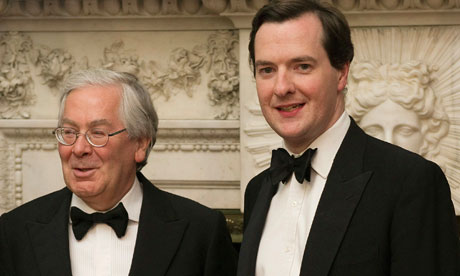
Mervyn King and George Osborne on 16 June 2010
The head of the Bank of England Mervyn King privately criticised David Cameron and George Osborne for their lack of experience, the lack of depth in their inner circle and their tendency to think about issues only in terms of their electoral impact, according to leaked US embassy cables. Photograph: Carl Court/AFP/Getty Images

5.06pm: Over at the Red State blog for red-meat Republicans, some writers are clear how the US should deal with Julian Assange – a bullet in the head:
Assange is a foreign national involved in illegally obtaining classified information that is vital to America's national security and distributing it to our foreign enemies. In other words, he is a spy who has been caught spying. Under the traditional rules of engagement he is thus subject to summary execution and my preferred course of action would for Assange to find a small caliber round in the back of his head.
Alternately, however, I would also support his arrest and lifetime incarceration (provided he'd be housed in a particularly notorious State prison), as would virtually everyone I know who doesn't cheer for the defeat and humiliation of America in the world.
4.49pm: Not all Republicans are calling for Julian Assange's capture, trial and execution. Connie Mack, a reliably right-wing Republican congressman from Florida, is unusually mature on the subject, saying "the blame here should fall on the administration and the Department of Defense."
"If they don't want the information to get out, then they need to have procedures in place to make sure that information doesn't get out," said Mack, who also agrees that Americans should have access to the contents of the cables: "I think that we do have a right to know."
Even more extraordinary was that this conversation took place on Fox News.
4.26pm: Der Spiegel has more detail on Daniel Domscheit-Berg's forthcoming book, Inside WikiLeaks:
A spokeswoman for the publisher told Spiegel Online that there were no immediate plans to publish an English version, but that it was "entirely possible" that the book might be translated.
There would certainly be a market here in the US.
WikiLeaks founder Julian Assange attends a seminar in Stockholm WikiLeaks founder Julian Assange at a seminar in Stockholm earlier this year. Photograph: Reuters
4.06pm: The Guardian's Berlin correspondent, Kate Connolly, reports on some of the internal tensions within WikiLeaks itself, and news that self-styled "WikiLeaks dissidents" plan to explain their own thinking:
WikiLeaks's former spokesman, Daniel Domscheit-Berg is to publish a book about his time with the organisation before he and other members left after fundamental disagreements with Julian Assange over its running.
In a revealing interview with the Berlin daily Die Tageszeitung, Domscheit-Berg says he and other WikiLeaks dissidents are planning to launch their own whistleblowers' platform later this month, whose aim will be to release a broader and less US-centric range of leaked documents to a wider audience, fulfilling WikiLeaks's original aim to have "limitless file sharing".
"As many people as possible should have access to as many documents as possible," he said, adding that Assange had gone against the will of others in the organisation by "making deals" with media organisations meant to create an "explosive effect", which others in WikiLeaks either learnt little about at the time or found out about only much later.
Domscheit-Berg, whose book Inside Wikileaks is due to be published at the end of January is highly critical of the "lack of transparency" at WikiLeaks, and of Assange's "autocratic leadership", saying he "would no more trust it as an organisation than I would any other organisation with similar problems".
A spokeswoman at Econ Verlag publishers told the Guardian that Domscheit was soon due to deliver the manuscript, which then had to be submitted to lawyers before publication.
"It should be good timing though," she said, noting that its sale would coincide with Assange's promise of a fresh deluge of revelations concerning a major US bank.
3.54pm: As we mentioned below, Republican presidential candidate Mike Huckabee – the former governor of Arkansas – thinks the death penalty is the minimum the cable leaker should suffer. Huckabee also said:
"I believe they have committed treason against this country, and any lives they endanger, they're personally responsible for and the blood is on their hands."
Huckabee made his comments while signing copies of his book, Can't Wait For Christmas ("a heartwarming story" – mikehuckabee.com).
Richard Adams
3.37pm: Good morning from Washington DC, where it isn't so much leaking as tipping it down outside. WikiLeaks remains on the top of the news agenda as more and more details emerge from the US embassy cables.
3.28pm: They may be frantic behind the scenes, but in Pakistan politicians are presenting a united front with the Americans, according to Declan Walsh.
The US ambassador, Cameron Munter, paid a visit to the Pakistani prime minister, Yousaf Raza Gilani, at his hilltop residence in Islamabad, where the men downplayed the significance of the leaked diplomatic dispatches.
Gilani said Pakistan's national interests "would not be compromised by such mischief in any manner". At a bridge opening ceremony earlier in the day, Munter said: "Working together, we will get past the WikiLeaks problems."
Live blog: substitution I'm WikiLeaked out for today. Time to hand over to Richard Adams in Washington.
3.25pm: Diplomats and foreign policy lobbyists in Washington are in permanent crisis-mode, frantically trying to contain the damage over the leaks, according to Josh Rogin in Foreign Policy magazine.
When was the last time that every embassy and every consultancy in town went into crisis mode simultaneously," one consultant with clients in Europe and Asia told The Cable. This consultant said that his firm has been totally swamped since Sunday's initial document dump with panicked emails, rushed conference calls and requests for information.
"Basically you have governments that have absolutely no idea what's in these documents. And everybody from senior officials to embassy personnel to Washington consultants are in a mad scramble to go through each new batch of documents as they come out to identify items that are potential vulnerabilities, paint their bosses in an unflattering light, or reveal some sensitive information," the consultant said. "The entire chain of command is in panic mode with every new release."
At the embassies themselves, foreign diplomats are working day and night to try to collect as much information as possible about the coming leaks that reference their own country. One European diplomat said that his embassy had set up an around-the-clock monitoring system to make sure that if something breaks, they will be ready to handle it immediately.
One Washington lobbyist who represents countries in the Middle East said that local press in several countries he works on is reporting on cables that haven't yet been reported on by the media outlets who had advance access to the documents. The lobbyist speculated that foreign governments may also be selectively leaking cables they've come across to spin them in their own favour before WikiLeaks or local media has a chance to get involved.
"New leaked cables are coming from weird sources, thinktanks, the countries involved. There's a lot of stuff being quoted in local press from cables that haven't been released yet and I have no idea where they are coming from," this lobbyist said.
2.53pm: Sources close to the Canadian prime minister, Stephen Harper, have asked us to point out that Tom Flanagan, the professor who flippantly called for Assange's assassination (8.38am), does not have a formal role as an adviser to Harper.
Canada's respected magazine, The Walrus, carried a long profile of Flanagan in 2004. It was headlined "The Man behind Stephen Harper".
We should have made clear that Flanagan is a former adviser to Harper. The 8.38am post has been changed.
2.28pm: The Turkish prime minister Recep Tayyip Erdogan has threatened to sue the Americans after some of the cables accused him of corruption.
"This is the United States' problem, not ours... Those who have slandered us will be crushed under these claims, will be finished and will disappear," he said according Hürriyet Daily News.
It adds:

One leaked cable that was signed by former US envoy to Ankara Eric Edelman claimed that Erdogan had eight secret accounts in Swiss banks, a claim the American diplomat said had been made to the US Embassy by two contacts. He did not give further evidence. Other documents accused Erdogan of reaping personal gain from a billion-dollar privatisation.
2.07pm: Mervyn King has won the backing of former MPC member Charles Goodhart. He said David Blanchflower's call for King to go was "ludicrous", according to the Telegraph.
"The comments on WikiLeaks make it perfectly clear that the Governor is not in the pocket of the Coalition at all. If anything, they underline how independent of any political party he has been," he said.
1.59pm: If you're a bit overwhelmed by the gush of WikiLeak stuff this is useful. My colleague Haroon Siddique has summarised today's key points.
1.32pm: In 2007 the then US ambassador to London, Robert Tuttle, sent a wonderfully irascible cable about the congestion charge in London. Here's the key quote:
London Mayor Ken Livingstone has focused his ire publicly against the US Embassy and the Ambassador personally. His position, however, should be seen in the wider context of his anti-American positions on many issues and his coziness to the likes of Hugo Chavez and Fidel Castro.
Jason Burke
12.53pm: Jason Burke in Delhi reports on Indian reaction to the cables.
Revelations from WikiLeaks are leading many bulletins in India today with reports focusing on American diplomats' comments about Pakistan's support for a range of militant organisations; Western fears that Pakistani nuclear fuel may fall into terrorist hands; and the suggestion that Pakistani Chief of Army Staff Ashfaq Kayani was close to ousting President Asif Ali Zardari in March 2009.
After two days of relatively muted reaction, the new documents from the American embassy in Islamabad are set to be plastered across front pages tomorrow and have provoked the first very careful - and deniable - response from the Indian government beyond banalities.
Until today coverage in India has focused on Hillary Clinton's mildly disparaging comments about India being a "self-professed frontrunner" for a permanent United Nations security council seat and her instruction to diplomatic staff to gather personal information about some of their Indian counterparts. Earlier in the week Indian newspapers worked themselves into slightly overheated outrage.
But the Pakistani documents take the story into new territory, touching on one of India's sorest points. Government officials are now anonymously briefing reporters that the documents prove that "Pakistan is hunting with the hound and running with the hare."
The Press Trust of India, the government news agency, has been running reports of the WikiLeaks documents at the head of its international news section. Coverage is also focusing on the issue of the disputed Himalayan state of Kashmir and particularly the view of Anne Patterson, US ambassador in Islamabad, that resolving the 63-year-old Kashmir conflict "would dramatically improve the situation".
There is also much interest in US diplomat's appraisal of India's ability to implement their controversial "Cold Start" doctrine for a rapid but limited military operation to punish Pakistan in the event of a terrorist strike emanating from their neighbour.
Tim Roemer, the US ambassador to India, described "Cold Start" as "a mixture of myth and reality" in one cable. There is also some interest in views across the border.
CBN-IBN ran an interview with the retired Pakistani general Asad Durrani saying the cables "did not reveal anything that people are not already aware of. These things have been said continuously for so many years."
However, experts caution that India's often sensationalist media may be overreacting. "There certainly won't be much effect on the Indo-Pak relationship. What is coming out really just emphasises the growing convergence of opinion between the Indian analysis and that of international politicians and diplomats. That will be the biggest effect," said Ashok Behuria, of the Institute for Defence Studies and Analyses in Delhi.
News has also just broken that India has also denied a visa to former Pakistani President Pervez Musharaf, who was to visit to address media meetings and think tanks in Delhi this weekend.
12.47pm: Former members of WikiLeaks, who fell out with Assange, are to launch a rival whisteblowing website later this month, Der Spiegel reports.
It sounds like it will have a greater European focus. The activists criticise WikiLeaks for concentrating too much on the US and want to take a broader approach, Der Spiegel says citing the German newspaper Die Tageszeitung.
"As many people as possible should have access to as many documents as possible," the former Germany spokesman for WikiLeaks, Daniel Domscheit-Berg, told the newspaper.
12.40pm: Bafflement all round at Ed Miliband's failure to mention Mervyn King's criticisms at PMQ.
Kevin Maguire, the Daily Mirror associate editor, tweets: "Ed Miliband's got a better economic argument but failed to make it. Or quote Mervyn King at lightweight Cameron. Inexplicable."
12.32pm: In the event PMQ's was surprisingly light on WikiLeaks references. But the Labour leader Ed Miliband couldn't resist a jibe using the "children of Thatcher" line. (Here's that cable again). "I'd rather be a child of Thatcher than a son of Brown," Cameron replied.
12.18pm:Tyrannical, thin-skinned, erratic and flash - the cables don't paint a flattering portrait of Nicolas Sarkozy. But it is his pro-American stance that is causing the biggest stir in France, writes Angelique Chrisafis.
Angelique Chrisafis
Le Monde's analysis of cables from the US embassy in Paris today focuses on Sarkozy's stance as the most pro-American French leader since the war and his efforts to woo the US.
A 2006 cable cited by the paper details how Sarkozy, a year before running for president, suggested that France and the international community would have to help the US in Iraq, perhaps by replacing the American army with "an international force".
The hint that Sarkozy might have sent French troops to Iraq has shocked France this morning. No French troops were ever deployed in Iraq, and the idea was never mooted once Sarkozy became presidential candidate. Sarkozy, like Jacques Chirac, was against the Iraq war, although, the cables show he felt Chirac was "excessive" in the way he showed his opposition to the US over the invasion.
Even with the damning US views of Nicolas Sarkozy's personality released by the Guardian and Le Monde today, French commentators remain sniffy about the WikiLeaks cables.
Both the right and left have complained of the "tyranny of transparency".  Hubert Védrine, the former socialist foreign minister this morning echoed the warning, from Sarkozy's rightwing government, of a "dictatorship of transparency". He likened the information age and the quest for total openness to the totalitarianism of Mao's China. He said diplomacy was like a family: certain things should not be said in front of the grandparents and the kids.
The journalist and commentator Bernard Guetta wrote in the left-wing paper Libération that confidentiality must be respected and unless the cables revealed major corruption scandals, publishing them was not journalism.
France, which has strong privacy laws and a press in crisis over self-censorship and kowtowing to the government, is wary of the publication of the WikiLeaks cables. 
11.59am: Now might be a good time to go over to Andy Sparrow's politics live blog for all the WikiLeaks fallout at PMQs.
11.55am: Downing Street sounds a little exasperated by the continuing questions about WikiLeaks in general and Mervyn King's comments in particular. Here are the latest lines from PA.
Cameron's spokesman refused to answer questions about the WikiLeaks documents at a regular daily media briefing in the House of Commons.
In response to further questions, he said that the prime minister believes the governor is doing a "good job", but declined to respond when asked whether he retains Mr Cameron's confidence.
"The issue of confidence simply doesn't arise," he said.
11.47am: US officials tried to influence Spanish prosecutors and government officials to head off court investigations into Guantánamo Bay torture allegations, secret CIA "extraordinary rendition" flights and the killing of a Spanish journalist by US troops in Iraq, writes Giles Tremlett in Madrid.
11.40am: Prime minister's questions at midday. It is sure to be spiced by Mervyn King's comments about Osborne and Cameron. Andrew Sparrow will be covering on the the politics live blog.
11.33am: Hillary Clinton has emerged from that OSCE summit in Kazakhstan to answer more questions about WikiLeaks.
She said had discussed the the leaked cables with her international colleagues, according to AP.
11.24am: One of the cables quoted Tory party officials in October 2008 expressing concern about George Osborne's "high-pitched vocal delivery".
A month later the Daily Mail published a story about Osborne having voice-coaching lessons from a £100-per-hour Harley Street expert.

Some observers claim that in the past year his voice has dropped in tone and his speaking style sounds less posh.
11.01am: The British government gave secret assurances that it would "protect US interests" at the Chilcot inquiry, the Telegraph reports.
10.40am: William Hague said he, David Cameron and George Osborne were all "children of Thatcher" and staunch Atlanticists, according to one of the latest cables to be released.
10.25am: The Bank of England has issued a terse statement in support of King. "The governor has a very effective working relationship with both the chancellor and the prime minister," a spokesman said.
10.17am: Nick Clegg was sent to Kazakhstan for that tricky OSCE summit with Hillary Clinton. He said the leaks of the US cables would not harm the UK's "uniquely strong relationship" with the US.
Following his discussion with Clinton in the Kazakh capital Astana, Clegg said:
We discussed a wide range of issues, including Iran, Pakistan, Afghanistan, the Middle East peace process and Sudan.
I made clear to Secretary Clinton that recent WikiLeaks disclosures would not affect our uniquely strong relationship. UK-US co-operation will continue with the same depth and closeness as before.
10.05am: Mervyn King should resign, says his former monetary policy committee colleague, David Blanchflower.
Mervyn King is one smart guy and that has always been abundantly clear. Unfortunately, it is his thirst for power and influence that has clouded his judgment one too many times. He has now committed the unforgivable sin of compromising the independence of the Bank of England. He is expected to be politically neutral but he has shown himself to be politically biased and as a result is now in an untenable position. King must go.
9.35am: Yet more rabid reaction in America. Former Pentagon official KT McFarland, said Manning should be executed and WikiLeaks declared a terrorist organisation.
9.24am: More WikiLeaks hysteria. The Republican presidential hopeful Mike Huckabee said the person responsible for the leaks should face the death penalty.
"Whoever in our government leaked that information is guilty of treason, and I think anything less than execution is too kind a penalty," Huckabee said according to Politico.
9.20am: The respected Middle East analyst Juan Cole finds evidence in the latest cables of British impatience with the diplomatic process last year over Iran's nuclear programme.
One cable shows Simon McDonald, head of the foreign and defence policy secretariat at the Cabinet Office, said Gordon Brown wanted to impose a 30-day deadline on Iran.
"That sort of impatience does not comport with genuine diplomacy, and it seems clear that the British were eager to impose further sanctions as soon as possible," Cole writes.
He said the cable also suggested that the UK and the US wanted to get hold of Yukiya Amano, the then incoming head of the International Atomic Energy Agency, and "twist his arm to be more alarmist in his reports on Iran."
8.55am: US state department spokesman PJ Crowley was repeatedly pressed to explain disclosures that US diplomats were ordered to spy on the UN leadership.
We've published an extended extract of the exchange. It included this defence from Crowley:

Diplomats are diplomats and their job is to interact with people, gather information, gain a perspective of events around the world, and report those findings in a way that helps inform our policies and inform our actions. They are not intelligence assets. It can be useful for a diplomat to understand from Washington – you have a diplomat out in any place in the world, hey, there are issues that are of particular interest to the United States government. If you come across information that might be relevant to these issues, let us know. That's … those are … that is something that diplomats actually do every day. But one particular cable does not turn a diplomat into an intelligence asset.
8.38am: The anti-WikiLeaks campaign is now becoming hysterical. Tom Flanagan, a former adviser to the Canadian prime minister Stepher Harper, called for the assassination of Julian Assange on a CBC news programme.

The "shockingly flippant" comment is being seen as a fatwa against Assange.
8.29am: The leaks are "embarrassing" and "awkward," the US defence secretary Robert Gates admitted last night. But he said the consequences for American foreign policy should be limited. CNN uploaded this video of his remarks.

8.08am: Hillary Clinton faces an awkward time today at a summit of the Organization for Security and Co-operation in Europe in Kazakhstan. Among the delegates are the UN secretary general Ban Ki-moon, who US diplomats were instructed to spy on, along with other UN leaders.
Meanwhile, Hillary's husband Bill said he expects lives will be lost as a result of the leaked cables.
"I'll be very surprised if some people don't lose their lives," the former president said in a speech in North Carolina, according to AP. "And goodness knows how many will lose their careers."
Speaking to reporters after the event Bill Clinton said Julian Assange is trying to evade the reach of American law because he knows what he did was criminal.
"That doesn't mean that he did succeed in evading the reach of American law," he said.
7.57am: Prince Andrew is also under the cosh.
Republic spokesman Graham Smith said today: "On one hand Andrew is seeking private briefings from the Serious Fraud Office, on the other he is railing against the SFO and apparently condoning bribery in the course of international trade."
Still not a peep from Buckingham Palace on all this.
7.39am: Interpol is on his back, Sarah Palin wants him to be hunted down like a terrorist – it couldn't get much worse for Julian Assange, and now his mum has now piped up to talk of her distress at his plight.
According to the Sydney Morning Herald she said: "He's my son and I love him and obviously I don't want him hunted down and jailed. I'm reacting as any mother would – I'm distressed."
She added: "A lot of stuff that's written about me and Julian is untrue".
7.23am: Will Mervyn King be forced to resign? Not necessarily. In a detailed blogpost analysing the cables, our chief political correspondent Nick Watt writes that in some respects the disclosures are helpful for the governor.
Nicholas Watt
The publication of King's private thoughts is a mixed blessing for the governor. On the one hand the cable may feed the perception, voiced last week by the monetary policy committee member Adam Posen, that the governor is "excessively political". Posen complained that the governor was unwise to endorse the speed of the Tories' deficit reduction plans in May. But on the other hand King may be able to claim that his criticisms of Cameron and Osborne show he is no Tory cheerleader.
7.09am: It's bumper day of WikiLeak revelations. There's lots to get through so here's a summary of the main stories today:
• Mervyn King, the head of the Bank of England, privately criticised David Cameron and George Osborne for their lack of experience, the lack of depth in their inner circle and their tendency to think about issues only in terms of their electoral impact. Here's the cable.
• George Osborne lacked gravitas before the election and was seen as a political lightweight because of his "high-pitched vocal delivery", according to private Conservative polling relayed to US embassy diplomats. Here's the cable.
• The defence secretary, Liam Fox, told the Americans that the Tories would be tougher on Pakistan because they were less reliant on votes from the Pakistani community than Labour.
• The Liberal Democrats' two top strategists, Polly Mackenzie and Chris Saunders, now both working in government, planned to run a fierce anti-Cameron election campaign, describing him as "out of touch with real life". The death of Cameron's son Ivan forced them to drop the plan since it "eliminated these vulnerabilities".
• American and British diplomats fear Pakistan's nuclear weapons programme could lead to fissile material falling into the hands of terrorists or a devastating nuclear exchange with India
• Pakistan's army is covertly sponsoring four major militant groups, including the Afghan Taliban and Mumbai attackers Lashkar-e-Taiba.
• US special forces soldiers have been secretly embedded with Pakistani military forces in the tribal belt, helping to hunt down Taliban and al-Qaida fighters and co-ordinate drone strikes.
• The cables make a number of other embarrassing disclosures about Pakistan including: president Asif Ali Zardari's preparations in case he gets assassinated; and the army chief's plan to oust Zardari.
• A series of classified US memos depict the French president Nicolas Sarkozy as a self-absorbed, thin-skinned, erratic character who tyrannises his ministers and staff.
• Meanwhile, the WikiLeaks founder, Julian Assange, is facing growing legal problems around the world, with the US announcing that it was investigating whether he had violated its espionage laws. And Bradley Manning, the intelligence analyst suspect of leaking the cables, faces 52 years in jail.
You can follow all of yesterday's events on Tuesday's live blog.