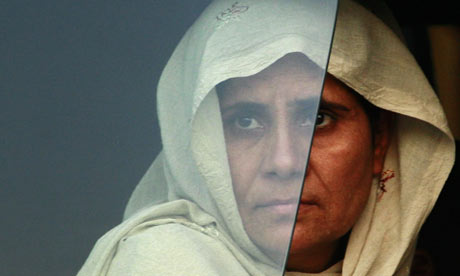
A woman in the Swat Valley region of Pakistan where the WikiLeaks cables claim hundreds were killed during fighting between the army and Taliban. Photograph: Reuters
A deeply entrenched "culture of revenge" in the Pakistani army led to a spate of murders during fighting against the Taliban in Swat and the tribal belt, according to a secret US assessment last year.
But while US diplomats voiced private concerns about the killings – now admitted to number in the hundreds – they deemed it was better not to comment publicly in order to allow the Pakistani army to take action on its own.
Last October, one year after the assessment was sent to Washington, US officials made moves to sanction several Pakistani military units accused of the killings. Pakistan's army chief, General Ashfaq Kayani, has also launched an investigation.
"A growing body of evidence is lending credence to allegations of human rights abuses by Pakistan security force" during fighting in the Swat valley and the tribal belt, the US ambassador, Anne Patterson, wrote in September 2009.
She said the most worrisome allegations concerned murders in which both regular army and paramilitary frontier corps soldiers – who are drawn from the Pashtun tribes – were implicated.
Patterson said cultural traditions meant revenge killings were "key to maintaining a unit's honour", while commanding officers complained that Pakistan's weak judicial system was incapable of prosecuting detainees.
Commanders feared that if detainees were handed over to the courts and formally charged, they would be released, placing army and frontier corps troops at risk.
Pakistani police were also involved in the killings but were dealt with through a separate chain of command, she said.
An estimated 5,000 detainees – picked up during anti-Taliban operations in Malakand division, which includes Swat, and Bajaur and Mohmand tribal agencies, along the Afghan border – were at risk, she said.
Patterson proposed a number of measures to counter the problems, ranging from offering human rights training and promoting prison reform, to helping draft a new law that would create a "parallel administrative track" for charging and sentencing combat detainees. British officials could help draft the law, she suggested.
The cable contained no mention of the Leahy amendment, a 1997 US legal provision that obliges the government to cut funding to foreign military units found guilty of serious human rights violations.
"Post fully recognises that there is little that the [US government] can do to change the culture of revenge that underlies many of the extra-judicial killings," the ambassador wrote. "However, it is our view that if senior commanders are offered a viable alternate to deal with detained combatants … the prevalence of human rights abuses will diminish.
"Much of this is dependent on goodwill … that can easily erode if too much public criticism from USG [US government] officials over these incidents is forthcoming. For this reason, post advises that we avoid comment … and that efforts remain focused on dialogue and the assistance strategy."
Senator Patrick Leahy, author of the Leahy amendment, told a reporter: "I am not going to close my eyes to it because of our national interests in Pakistan."
Sources told the Guardian that the targeted units included elements of the 12 Punjab infantry regiment and the paramilitary Frontier Corps. By conservative estimates at least 300 people have been murdered by security forces in Swat since 2009. But at a meeting in Washington in September, Admiral Mike Mullen, the chairman of the US joint chiefs of staff, told human right activists the real number was much higher.
• Latest leaks show China ready to abandon North Korea
• Prince Andrew's sweary outbursts at media and French
• Hillary Clinton leads international condemnation of leaks
This page will update automatically every minute: On | Off
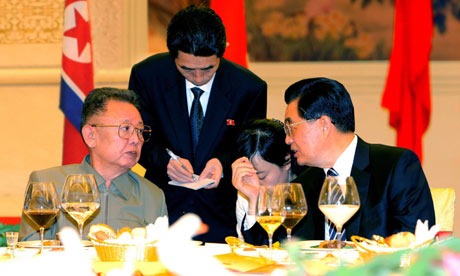
The latest diplomatic cables disclosed by WikiLeaks show that China is ready to accept a reunified Korea and regards North Korea as a spoiled child. Photograph: KCNA/EPA
"I don't agree with Secretary Clinton that it's that significant it has torn up the fabric for our diplomacy," Carter said. "In the future, there's going to be a lot more caution as leaders send them dispatches into the State Department and as our own ambassadors send reports back into the State Department if they suspect that their words might be revealed."
4.26pm: While there's a lot of talk about the damage these cables might do, NBC's Michael Isikoff has highlighted a case where the leaked information will be used as "a recruiting and propaganda tool" by al-Qaida. This is the revelation that the Yemeni government covered up the American role in missile strikes that killed 41 civilians, including 14 women and 21 children. Isikoff reports:
"President Saleh's comments will be translated and used over and over again by al-Qaida in the Arabian Peninsula (AQAP) as a recruiting and propaganda tool," Gregory Johnsen, a leading U.S. expert on the terror organization's Yemeni affiliate, told NBC on Monday. "His statements and those of his top ministers of deceiving and lying to the Yemeni public and parliament … fit seamlessly into a narrative that AQAP has been peddling in Yemen for years. This is something AQAP will take immediate and lasting advantage of."
4.05pm: From one pole of US politics (Santorum) to another: Noam Chomsky, speaking to Democracy Now!, says that while the cables reveal Arab leaders urging the United States to attack Iran, opinion polls in the region tell a different story:
What this reveals is the profound hatred for democracy on the part of our political leadership.
The Democracy Now! site reminds us that back in 1971, Chomsky helped whistleblower Daniel Ellsberg release the Pentagon Papers – and Ellsberg popped up on television last night to defend WikiLeaks, as mentioned below at 10.15am.
3.58pm: Former senator Rick Santorum – best known for his ferocious opposition to homosexuality – is one of the dozens of Republicans who fancy being president – and he used a trip to New Hampshire, the birthplace of presidential ambition, to denounce WikiLeaks founder Julian Assange:
"We haven't gone after this guy, we haven't tried to prosecute him, we haven't gotten our allies to go out and lock this guy up and bring him up on terrorism charges. What he's doing is terrorism, in my opinion."
3.40pm: Thank you Matthew and good morning from a damp Washington, where the US's bloggers and other media are still transitioning from their knee-jerk "this is old news" response to deciding that there is in fact some hot stuff amongst the cables.
The Washington Post's neo-conservative leader writers today dismiss the cables as "embarrassing to their authors or subjects, but otherwise harmless", and save their attention for how the leak happened in the first place:
Of course there must not be firewalls that prevent senior intelligence analysts and their bosses from seeing and sharing sensitive information. That does not mean a troubled 22-year-old in Baghdad should have access to secret State Department cables from all over the world. Surely there is a way to create a system that can do the former while preventing the latter.
That's it from me. The charming Richard Adams is about to breeze in from Washington.
3.21pm: The American Shanghai-based writer Adam Minter seizes on a tantalising looking cable suggestion corruption in China. It claims that a payment of $10,000 was offered to secure the support of premier Wen Jiabao for a mining contract for a North Korean copper mine.
Now, you don't need to know anything about graft in China, much less world leaders, or Wen Jiabao, to know that $10,000 not only wouldn't get the job done, it'd be viewed as an insult and an automatic disqualification from this any other mining contract. So I'm going to go out on a limb here: there's simply no way that happened. None. Zero. Zilch. Now, is it possible that Wen has a "relationship" with Wanxiang? Sure. But not the one described in the cable.
And this gets to something that I think is going to become increasingly, uncomfortably obvious as more and more of these cables are released: US State Department employees in overseas posts often don't know very much about the countries in which they're posted
It is likely to get fuller over the next few days.
2.16pm: The US embassy cables story gets the bizarre news animation treatment from Taiwan's NMA. Taste alert: it includes Uncle Sam taking biometrical details from a UN official in a toilet bowl. And Messrs Sarkozy, Putin, and Gaddafi are not spared.
Lake says the cables reveal that Arab leaders are much more bullish about Iran than Israel.
They go on to discuss whether suspected leaker Bradley Manning is a traitor or whistle blower. Drezner says that journalists are better at handling this kind of information than Julian Assange.
1.51pm: There's been more response to Gordon Brown's failed bargaining with the Americans over Gary McKinnon.
Shami Chakrabarti, of Liberty, said:
While it is to Brown's credit that he pleaded with the US on behalf of Gary McKinnon, [Tony] Blair's shame is that the rights of people in Britain were signed away and left to special secret pleadings instead of law.
No one should be sent anywhere without evidence in a local court and where justice and mercy suggest dealing with them at home.
Former home secretary David Blunkett told the home affairs select committee that he knew about Brown's appeal to the US at the time.
I remember discussing it with (current Justice Secretary) Ken Clarke in a private meeting that it would be a really good idea for this case not to end up being a political football.
Although the [extradition] treaty itself is not responsible for the immediate removal of Gary... there was an issue for senior politicians to make representations.
1.27pm: The German magazine Der Spiegel provided a teaser of what some of the documents will say about Kenya. "Viewed through the eyes of the US diplomats, entire states -Kenya for example - appear as mires of corruption," it said.
Alfred Mutua, Kenyan government spokesman, delivered an angry response. "If what is reported is true, it is totally malicious, and a total misrepresentation of our country," he told a press conference, recorded by Capital FM Kenya.
The spokesman also revealed that the US government had apologised.
1.09pm: Business secretary Vince Cable has chirped on the Prince Andrew front.
He said anti-corruption policy is "not a matter" for the Duke of York and he should stop talking about it. Speaking to Sky News Cable said it would be "helpful" if he the prince steered clear of policy issues.
"But his contribution is a very positive one and I want to encourage him to continue to make it," he diplomatically added.
12.32pm: Saeed Kamali Dehghan has more on the Iranian reaction to the cables.
In Iran the release of the cables has been overshadowed by the assassination of two nuclear scientists. But today opposition websites started covering the leaks more widely.
Nikahang Kowsar, a prominent Iranian cartoonist, based in Canada, suggested that Hashemi Rafsanjani, an influential Iranian cleric thought to be sympathetic to the opposition, could be his successor. Rafsanjani is dipicted sitting on a egg timer next to an ailing Khamenei.
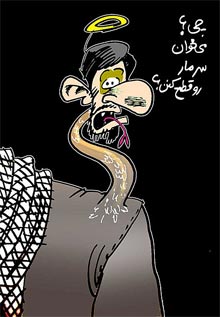
Another cartoon by Kowsar picks up the view of the Saudi Arabia's King Abdullah that Ahmadinejad is the head of a snake that needs cutting off.
It was a theme taken up today by Iran's foreign ministry spokesman, Ramin Mehmanparast. IRNA, Iran's state news agency, quoted him saying "As the president stated yesterday, this action is very dubious and it should not be taken seriously."
He added: "They [Wikileaks cables] were revealed in order to create quarrels between countries, they want to create an Iranophobia between nations."
12.20pm: Our Paris correspondent Angelique Chrisafis reports on the reaction in France, where Le Monde has been poring over the cables.
Le Monde is preparing to release documents relating to France in the coming days. The paper said these will give US view of Paris's anti-terrorism policy, Washington's interpretation of the suburb riots of 2005 and France-US relations.
But the French media, left and right, today slammed the publication by the Guardian and others of the US embassy cables. The right-wing Le Figaro, close to the French government, ran an editorial entitled "The tyranny of transparency" saying: "The massive diffusion of secret documents belonging to American diplomacy is an act of malice, about which it would be very naïve to rejoice."
The left-wing Libération warned that "in a world of violent conflict", states had a "right" to their secrets, adding that the private positions so-far revealed were little different from what the governments were saying in public.
The Socialist party was as critical of the leaks as Sarkozy's right-wing UMP party. The socialist Jean-Christophe Cambadélis complained of "the tyranny of transparency with no limits" . Socialist spokesman Benoît Hamon said he was "not really in favour" of the publication of the cables.
Josselin de Rohan, the UMP head of the foreign affairs commission in the French senate, said the publication was "very serious" and raised questions of blackmail and voluntary disinformation: "I think we've gone over the boundary here of what's possible in the domain of information."
Francois Baroin, budget minister and government spokesman, told Europe1 radio, "I always thought a transparent society would be a totalitarian society." He said Sarkozy thought the leaks were "irresponsible to the last degree".
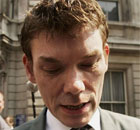
12.11pm: Janis Sharp, Gary McKinnon's mother, said she was "very surprised and very pleased" to hear that Gordon Brown had tried to bargain with the Americans in an attempt to avoid his extradition.
"I wish I had known about that, because he [Brown] would have been given credit for it," she told the home affairs select committee.
She also criticised the Americans for refusing to budge. "They know this is a difficult decision for this government and yet they did not want to give leeway," she said. "The fact that people at the top are so intransigent, I find difficult to understand... I believe America wants Gary as an example of computer crime."
11.34am: Downing Street just told lobby journalists that the government's position on the extradition of Gary McKinnon has not changed. We don't quite know what its position is - the Cameron government has failed to announce whether or not it will comply with continued US demands to hand over McKinnon after he hacked into their government computers.
11.19am: NATO has joined the international condemnation of WikiLeaks after leaked cables revealed the European countries hosting US nuclear weapons.
NATO spokeswoman Oana Lungescu described the disclosures as "illegal and dangerous."
Louis Susman, the current US ambassador to London wrote: "PM Brown, in a one-on-one meeting with the ambassador, proposed a deal: that McKinnon plead guilty, make a statement of contrition, but serve any sentence of incarceration in the UK. Brown cited deep public concern that McKinnon, with his medical condition, would commit suicide or suffer injury if imprisoned in a US facility."
The ambassador says he sought to raise Brown's request in Washington with Obama's newly appointed attorney general, Eric Holder. But the plea got nowhere.
Asked on CNN's Larry King show about Hillary Clinton's condemnation of the WikiLeaks, Ellsberg said "There hasn't been a secretary of state who wouldn't have said exactly the same thing about the Pentagon papers.
"I'm sure in America they see Julian Assange as the most dangerous man. A truth teller is potentially very embarrassing."
Saving diplomats embarrassment was not enough of an excuse to withhold the information, he said.
9.55am: There's no mention of Ecuador in the haggling over Guantánamo Bay prisoners. But according to Al Jazeera, Ecuador has offered residence to someone to another US problem - Julian Assange.
"We are going to invite him to come to Ecuador so he can freely present the information he possesses and all the documentation, not just over the internet but in a variety of public forums."
Slovenia was promised more "high-level attention" if it helped with detainees; the Maldives said it would accept prisoners in return US help in getting IMF loans; and the Pacific nation Kiribati was offered $3m to take 17 Chinese detainees.
There's lots more including details a suggestion by King Abdullah of Saudi Arabia to implant electronic chips in the detainees.
9.13am: The chairman of North Korea's Supreme People's Assembly, Choe Thae Bok, arrived in Beijing today for a five-day visit, according to AP. He was summoned by China to discuss the current tension in the peninsula after the North unleashed a fiery artillery barrage on a South Korean island.
They have lots to talk about, but don't expect any leaked cables from that visit.
8.44am: Over to Tania Branigan in Beijing where Chinese officials have been making their first comments on the leaked cables.
Beijing called on the US to "properly handle" the emergence of the diplomatic cables, but sought to play down the issue in its first response to the release.
Foreign ministry spokesman Hong Lei told a regular press briefing: "We do not want to see any disturbance in China-US relations."
But he declined to comment on any of the issues raised in the documents. Asked whether Beijing believed that North Korea had behaved "like a spoilt child" – as a senior official remarked, according to one of the cables - Hong replied: "China takes note of the leaked reports. We hope the US side will properly handle the relevant issues. As for the content of the documents, we do not comment on that."
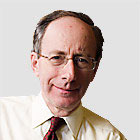
8.43am: Former foreign secretary Malcolm Rifkind said China will be "very very angry" with the disclosures on China's possible new stance on North Korea. "And rightly so," he told Today programme.
"The tragedy of these WikiLeaks is that if China is contemplating a historic change in its attitude to North Korea and possibly support for reunification, this premature revelation ... will have put that back by years. That shows the damage that can be done by unauthorised leaks from private conversations."
He said the documents on Korea, and the cables yesterday about Saudi Arabia's desire to attack Iran, should only have been available to handful of senior officials. "Clearly they [the Americans] lost control of the system," he said.
On Prince Andrew's comments Rifkind said they were "very unwise remarks to make". But he said he should carry on as trade envoy. "He is an extremely good trade representative. He has always been known to be a blunt speaker," he said.
It included some interesting comments on the Duke of York from Labour MP John Mann. He suggested that the Prince might have to resign as trade ambassador.
If these comments by Prince Andrew are accurate - and of course we don't know that yet - then clearly it's of public interest that they are out there, so that he can judge whether he is performing the role well and government can make that judgment as well.
Prince Andrew will need to think through if he is actually carrying out this role to the best of his abilities.
7.34am: The rest of the British media wasn't that interested in WikiLeaks disclosures yesterday. But that's all changed today now that royalty is involved.
The Daily Mirror's front page describes Prince Andrew as the Duke of Yuk (left), the Sun calls him the Tirade Envoy.
Inside the Telegraph devotes four news pages to following-up the WikiLeaks and Guardian disclosures, but its comment pages are sniffy about the exercise. "The mass release of American diplomatic cables by the WikiLeaks website has, so far, generated a great deal of heat but not a lot of light," its editorial says.
It is too early to say precisely what damage the WikiLeaks revelations will do. Many of us suspected that Arab leaders were even more alarmed than the West at the prospect of a nuclear-armed Iran. It does not surprise me that they would be supportive of a military attack if all other pressures fail. The fact that this is now public may bring home to the international community and, in particular, Russia and China, that the UN Security Council must agree very heavy sanctions and pressure on Iran if the whole Middle East is not going to be disrupted by conflict.
But regardless of whether the spotlight of unauthorised publicity might, occasionally, help rather than hinder, the deliberate leaking of sensitive dispatches and diplomatic cables is highly damaging in what is already a very dangerous world.
7.15am: Here's a catch-up on the current batch of leaked US diplomatic cables:
You can read all about yesterday's fun and games on Monday's liveblog. It includes verdicts on the first batch of revelations from a very eclectic cast of characters including: Sarah Palin; Mahmoud Ahmadinejad, Hillary Clinton, and a Today programme ding-dong between Sir Christopher Meyer and Alan Rusbridger.
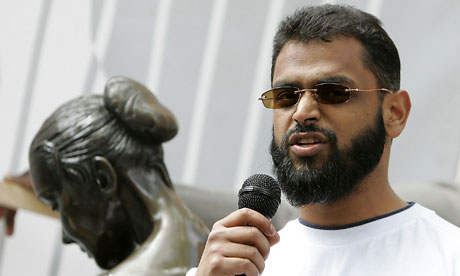
WikiLeaks cables show US U-turn over ex-Guantánamo inmate
Washington shown lavishing praise on Moazzam Begg over his campaign for Europe to take in other detainees
Former Guantánamo Bay detainee Moazzam Begg was praised by the US for his campaign for other countries to take in inmates, according to the WikiLeaks cables Photograph: John D Mchugh/AFP/Getty Images
The US has made a startling U-turn over the former British Guantánamo detainee Moazzam Begg, heaping praise on a man it accused only a few years ago of being a terrorist.
An American ambassador in Europe applauded in a leaked cable Begg's campaign to persuade European countries to take in remaining Guantánamo detainees.
Cynthia Stroum, ambassador to Luxembourg, acknowledges the irony of lavishing praise on Begg, who was alleged by the US to have been an instructor at an al-Qaida training camp in Afghanistan. In a cable labelled "To Hell and Back: Gitmo ex-detainee stumps in Luxembourg", Stroum wrote that Begg was "barnstorming" through Europe. In January this year, he met the Luxembourg government and spoke at a public meeting.
"Mr Begg is doing our work for us and his articulate, reasoned presentation makes for a convincing argument. It is ironic that after four years of imprisonment and alleged torture Moazzam Begg is delivering the same demarche to GOL [the government of Luxembourg] as we are: please consider accepting GTMO detainees for resettlement."
The cable is one of thousands offering insights into a massive US campaign led by the US secretary of state, Hillary Clinton, to coax reluctant countries around the world to take detainees. The cables show US diplomats resorting to flattery, pressure and financial inducements but still meeting with snubs, particularly from Europe.
The cables reveal extraordinary proposals for resolving the dilemma, such as a suggestion by Kuwait to dispose of the detainees by dropping them into the middle of a war zone. Almost as bizarre, though more humane, is a Saudi proposal to plant electronic chips in their bodies to track them after release.
There are 174 detainees left in the Guantánamo camps, which were established in 2002 and held 775 at their peak. Of those remaining, the US has said it plans to hold about 60-80 with a view to putting some on trial and keeping others in indefinite detention. It is looking for homes for the remainder.
Barack Obama promised to close Guantánamo by January this year but was unable to fulfil the pledge.
In a lengthy passage of praise for Begg, who was held for four years and whose release in 2005 was reportedly opposed by the FBI and the CIA, Stroum said: "Rather than stressing past injustices he focused on what to do now."
In spite of Begg's efforts, Stroum said, Luxembourg was not prepared to take detainees, a fairly common position among European countries.
One of the most alarming suggestions was offered by the Kuwaiti interior minister, Sheikh Jaber al-Khaled al-Sabah, in a meeting with a US ambassador in February last year. The ambassador expressed concern about releasing more Guantánamo detainees to Kuwait, citing Abdullah al-Ajmi, who returned to Kuwait but was reported to have blown himself up in a suicide attack in Mosul, Iraq, in 2008.
According to the cable, Jaber told the ambassador: "You know better than I that we cannot deal with these people. I can't detain them ... If they are rotten, they are rotten and the best thing to do is get rid of them. You picked them up in Afghanistan; you should drop them off in Afghanistan, in the middle of the war zone."
The White House chief counter-terrorist adviser, John Brennan, heard another unusual proposal from Saudi Arabia's King Abdullah at his palace in March this year.
Discussing how to deal with detainees, Abdullah interjected: "I've just thought of something." He proposed "implanting detainees with an electronic chip containing information about them and allowing their movements to be tracked with Bluetooth. This was done with horses and falcons." Brennan replied: "Horses don't have good lawyers." Brennan said such a proposal would face legal hurdles in the US but he would look into it.
The next day Brennan held another discussion on Guantánamo – with the president of Yemen, Ali Abdullah Saleh, who offered to take all Yemenis in Guantánamo into the Yemeni prison system. But the US, in a cable, expressed scepticism. "Saleh would, in our judgment, be unable to hold returning detainees in jail for any more than a matter of weeks before public pressure (or the courts) forced their release."
Talks with the Yemeni leader broke down because he was asking for too much money to set up a terrorist rehabilitation programme.
European countries listed a whole series of reasons for not taking detainees, citing public opposition through to lax anti-terrorist laws. The British government welcomed Obama's promise to close Guantánamo but told the US almost immediately it would take no more detainees. Robert Chatterton-Dixon, the British Foreign Office's head of counter-terrorism, in a discussion with embassy officials in February last year spoke of the implications of legal actions in the UK.
Referring to 12 detainees who were bringing a combined case in UK courts, one of which was settled in their favour this month, Chatterton-Dixon raised concern that the case was "likely to raise similar issues concerning access to classified information as had been raised in the Binyam Mohamed case".
The US intelligence agencies strongly objected when a British court ordered that intelligence data be made available in the case of Mohamed, a British resident who had been held at Guantánamo.
Concern over intelligence data is thought to be one of the reasons ministers agrees to pay millions in compensation last month.
In the case of Belgium, US diplomats attempted to play on the country's perceived weaknesses as a small player in Europe that wanted to be a big one. The US embassy in Brussels suggested to Clinton, ahead of a visit to the country late last year, that she might exploit this to US advantage by asking it to take more detainees. The embassy had "begun to suggest the possibility of Belgium stepping forward from the chorus line and up to the footlights on Guantánamo".
Sarah Palin has the gall to accuse Assange of having blood on his hands when BUSH lied to take the people into an illegal war and massacre thousands of Iraqis , now Iran in their line of fire...America only happy with Arab puppets, the rest they would like to wipe from the face of the earth. Palin, deranged , part of a very sick American regime. If her goal was to inflame the British people she has succeeded. It is the world who should fear America, their policing of the world and their aim to destroy those who do not go along with them is a very frightening place to be......The smear campaign of the rape allegation...an idea that could have only come from America...only an American would call a broken condom rape.
Hunt WikiLeaks chief down like Osama bin Laden: Sarah Palin demands Assange is treated like Al Qaeda terrorist
Australia looks into whether he has broken local laws
39-year-old is already facing rape inquiries in Sweden
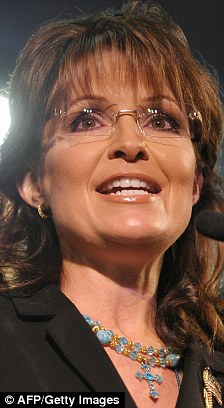
Sarah Palin has demanded that WikiLeaks founder Julian Assange is hunted down like Osama bin Laden.
In an extraordinary outburst on Facebook, the former Alaska governor attacked the White House for 'incompetent handling of this whole fiasco.'
'First and foremost, what steps were taken to stop Wikileaks director Julian Assange from distributing this highly sensitive classified material especially after he had already published material not once but twice in the previous months?.' she wrote.
Attack: Republican Sarah Palin (left) has claimed WikiLeaks founder Julian Assange should be treated like a terrorist
'Assange is not a "journalist," any more than the "editor" of al Qaeda's new English-language magazine Inspire is a "journalist."
'He is an anti-American operative with blood on his hands.
'His past posting of classified documents revealed the identity of more than 100 Afghan sources to the Taliban.
'Why was he not pursued with the same urgency we pursue al Qaeda and Taliban leaders?'
Palin claimed that the administration's inability to hunt down Assange showed a lack of effort.
It emerged today that the U.S. has opened a criminal investigation into whether the 39-year-old could be charged under its Espionage Act for releasing secret diplomatic documents.
And he is facing a separate criminal inquiry in his native Australia where police are investigating whether the latest leak has broken any local laws.
Mr Assange, who is believed to be in London, is already facing a criminal investigation in Sweden where two women have accused him of rape.
U.S. Attorney General Eric Holder today said the American government is in the midst of an 'active, ongoing criminal investigation' into WikiLeaks.
The latest disclosures, involving classified and sensitive State Department documents, jeopardised the security of the nation, its diplomats, intelligence assets and relationships with foreign governments, General Holder said.
On the warpath: U.S. Attorney General Eric Holder said the latest WikiLeaks disclosures jeopardised the security of the nation, its diplomats, intelligence assets and relationships with foreign governments
Speaking to the Washington Post, General Holder did not confirm whether Mr Assange would be charged for violations of the Espionage Act, nor whether such an indictment was imminent.
But former CIA general council Jeffrey H Smith told the newspaper: 'I'm confident that the Justice Department is figuring out how to prosecute him.'
Mr Assange was last night warned that he could face criminal charges if he ever returns to Australia.
Australian attorney general Robert McClelland said police are investigating whether the latest leak of secret U.S. documents had broken any Australian laws.
There have also been claims that the U.S. is putting pressure on Australia to cancel Mr Assange's Australian passport., but this was flatly denied by Mr McClelland.
A range of options were under consideration by Australian government agencies in response to the latest disclosure of classified U.S. material, he said.
Mr McClelland told reporters there were 'potentially a number of criminal laws' that could have been breached.
Australia's Defence Minister Stephen Smith said later that a cross-government committee was studying the documents to see what damage could have been done by their release.
Mr Smith said: 'We need to take it... step by step, but our starting and end point is essentially protecting Australia's national interest.
'This is an act which again one has no option but to absolutely condemn it. It potentially puts national security interests and it puts the safety and welfare of individuals at stake.'
Australian Prime Minister Julia Gillard last week condemned the planned leaks as reckless and potentially harmful to national security interests.
Senior U.S. politicians, meanwhile, have launched a series of scathing attacks against Wikileaks, even demanding for the website to be treated as a terrorist organisation.
Controversy: The WikiLeaks disclosures have made headlines around the world
Peter King, a Republican congressman and incoming chairman of the House homeland security committee, called on Washington to pursue aggressively Wikileaks and Mr Assange for violating the Espionage Act.
Senator Joe Lieberman, chairman of the Senate homeland security committee, said those responsible for the 'outrageous, reckless and despicable' leaks 'are going to have blood on their hands'.
He urged the U.S. to do everything it could to shut down the whistle-blowing website.
According to Peter Hoekstra, the senior Republican on the House intelligence committee, the documents contained a 'whole number of time bombs' and he described the likely breakdown in trust between the US and other countries as a 'catastrophic issue'.
Mr Assange is already facing a criminal investigation in Sweden where two women have accused him of rape.
He strongly denies the charges, which stem from his encounters with two women during a visit to Sweden in August.
Court documents filed by a Swedish prosecutor show Mr Assange is suspected of raping and sexually molesting a woman in the town of Enkoping, central Sweden.
He is suspected of sexual molestation and unlawful coercion of the second woman in Stockholm.
The prosecutor's office began an investigation into allegations of rape against Mr Assange in September.
The office now wants to detain him for questioning. If the request is granted, authorities could issue an international arrest warrant.
'The reason for my request is that we need to interrogate him. So far, we have not been able to meet him to carry out the interrogations,' said Marianne Ny, leading the case for the Prosecution Authority.
A police report shows that the women had met Mr Assange in connection with a seminar he gave in Stockholm on August 14. The women filed their complaints together six days later.
Investigators initially disagreed on how to deal with the case.
A Stockholm prosecutor started a rape investigation that was dropped by the city's chief prosecutor a day later. Ms Ny reopened it the following week.
He had been seeking to build a base in Sweden, where some his servers are located, because of its strict journalist protection laws.
Swedish immigration authorities denied Mr Assange a residence permit and earlier this month he said he may seek political asylum in Switzerland.
Murder bride's family: We're not ruling out anyone
By BRIAN FLYNN
Published: Today
THE brother of carjack murder bride Anni Dewani has said that her family are not ruling out any suspects.
Anish Hindocha said they were confused by rumours linking husband Shrien, 30, to her death.
The engineering student, 22, also said cops had left them completely in the dark.
Anish, who lives in Mariestad, Sweden, said: "We don't know anymore. We just want justice and we don't want to exclude anyone at this point.
"We're in limbo. There's a lot going on now, but we're not hearing anything."
Cops are still trying to work out why the honeymooners' cab was ambushed by gunmen in a notorious ghetto in Cape Town, South Africa.
Anni, 28, was found shot dead the next day. Shrien, from Bristol, survived after being dragged from the car.
The millionaire care home boss denies any part in the killing.
Meanwhile, prosecutors were last night confident that suspect Zola Tongo, 31 - the newlyweds' cabbie - would enter a plea bargain and reveal the plot behind the attack.
Tongo, Xolile Mngeni, 23, and Mzwamadoda Qwabe, 26, faced court yesterday charged with murder, kidnap and robbery and were remanded until Monday.
COMMENT: The Sun are not known for their honest reporting and I am dubious when they claim an 'EXCLUSIVE' they like to make it up as they go along if this should be the case b.flynn may be contacted at the Sun. Link provided.
The McCanns refused to hand over Madeleines medical records...with the releasing of the news that JonBenet was an abused child we have to now ask was Madeleine McCann an abused child and if she was why is the might of the British Goverment covering it up ?